







Video at bottom.
Mono Lake is a large, shallow saline soda lake in Mono County, California. It is located in the eastern Sierra Nevada mountain range. The lake was the backdrop for the town Lago in the 1973 Clint Eastwood film “High Plains Drifter”.
Clint Eastwood riding towards the lake.


In 1991 another film was shot at Mono Lake. And one of the characters in that film was very big and hairy.
Back in 2008, a science teacher from Orange County, California came forward and presented to the Bigfoot community one of the most intriguing footage of Bigfoot they had seen in a long time. The teacher said his family had viewed the vacation video privately for almost 20 years– not knowing he had captured a possible Bigfoot until his daughter pointed it out to him. The home video was taken in 1991, around Mono Lake, near the base of the…
View original post 961 more words
A tin toy, or tin lithograph toy, is a mechanical toy made out of tinplate and colorfully painted by chromolithography to resemble primarily a character or vehicle.
The production of tin toys was discontinued during World War II because of the need for raw materials in the war effort. After the war, tin toys were produced in large numbers in Japan. Under occupation and the Marshall Plan, manufacturers in Japan were granted the right to resume production. The idea was to give Japan all of the low profit; high labor manufacturing and the US companies could sell the imported product. It worked better than they had expected and Japan became a tin toy manufacturing force until the end of the 1950s. In the 1960s cheaper plastic and new government safety regulations ended the reign of tin toys. Presently, China has taken over the role of the leading tin toy manufacturing country.
Space Tin Toys










Norway


Central America

San Francisco


Germany

China
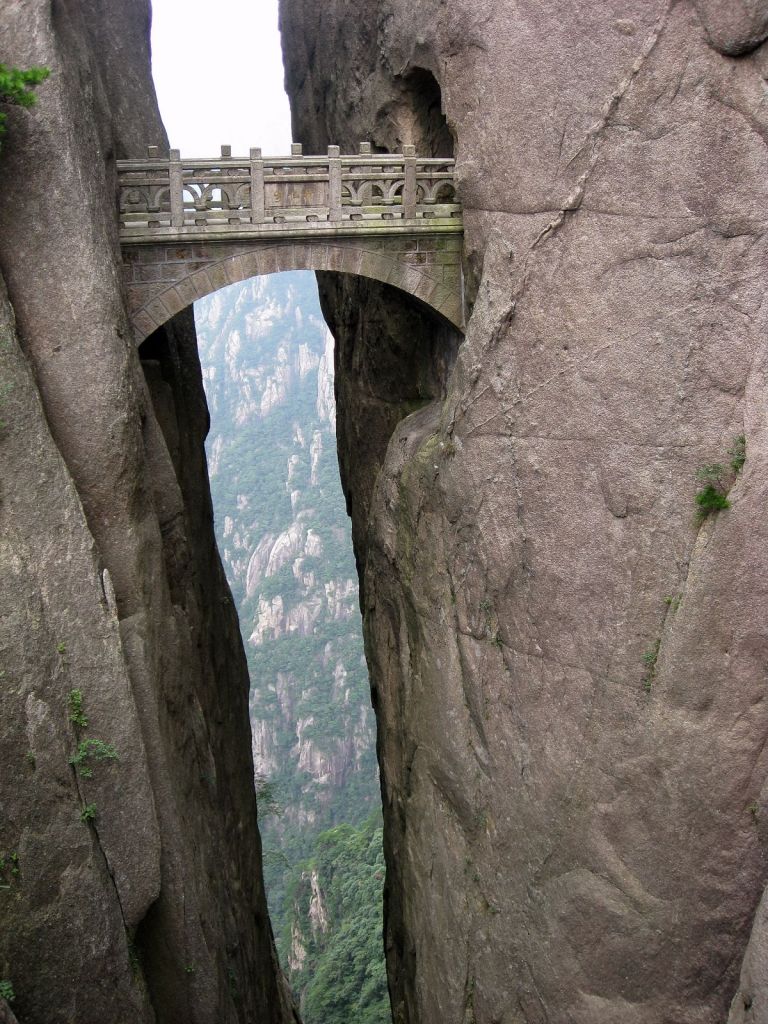
Malaysia
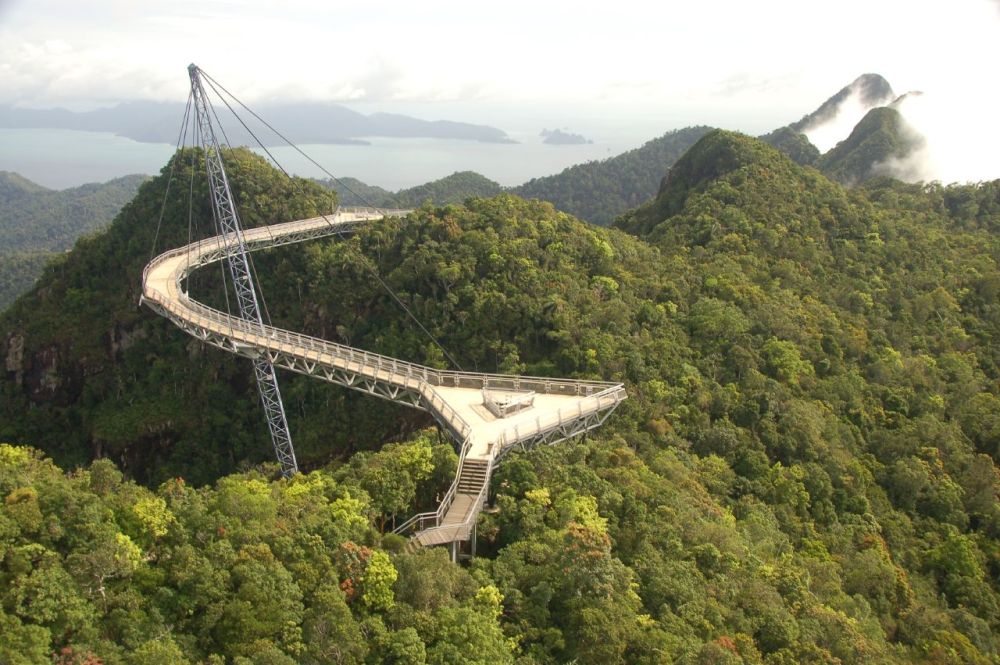
New York

Scotland

India

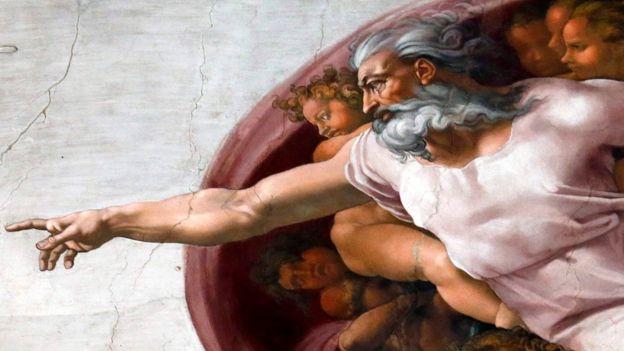
Philippine President Rodrigo Duterte has called God “stupid”, sparking anger in the largely Catholic country.
In a televised speech, he slammed the story of Adam and Eve’s fall from grace in the Bible and the logic behind the Christian concept of original sin.
Mr Duterte is well known known for his outrageous statements and unfiltered attacks on his rivals.
While the church and many citizens condemned his remarks, his office said he was expressing personal beliefs.
The president has in the past also criticised the Pope in crude language and has racked up a string of other statements widely deemed as highly offensive, cruel or misogynist.
His latest comments came at a speech in Davao, the city he governed as a mayor before running as president.
Asking “Who is this stupid God?”, Mr Duterte criticised the Biblical story of creation and Adam and Eve being thrown out of the Garden of Eden after they ate the “forbidden fruit”.
“You created something perfect and then you think of an event that would tempt and destroy the quality of your work,” he said.
The president also slammed the concept of original sin – whereby all humans are tainted by Adam and Eve’s wrongdoing – saying: “You weren’t born yet, but now you have original sin.”
“What kind of religion is that? I can’t accept it.”
Local Catholic bishop Arturo Bastes responded by calling the president a “madman” and urging people to pray for his “blasphemous utterances and dictatorial tendencies” to end.
Mr Duterte is a known and open critic of the Catholic Church in a country where more than 90% of the population are Christian and the vast majority of those are Catholics.
His outbursts therefore triggered a predictable backlash and debate online.
The president’s spokesman Harry Roque defended Mr Duterte’s comments as merely being his personal convictions. He also explained the outburst by referring to the president’s claim that he was abused by a priest at a Catholic school during his childhood.
Rodrigo Duterte took office in July 2016 on a hardline platform against crime and corruption. The brutal campaign of extrajudicial killings against drug dealers and users has since though sparked mounting criticism against the strongman.
Earlier this year, the International Criminal Court opened a preliminary inquiry into crimes committed during the drugs purge.
In 2017, Mr Duterte admitted to stabbing someone to death as a teenager.
His frequent rhetorical outbursts are often far beyond what’s considered acceptable by his critics.
He said he would be “happy” to slaughter millions of drug addicts in the country and has responded to international criticism of his policies by calling former US President Barack Obama a “son of a whore” and slamming the EU as hypocrites.
In April 2016, he spoke to an election campaign rally about the 1989 murder and rape of a female Australian missionary in Davao, where he was mayor at the time.
“I was angry because she was raped,” he said. “That’s one thing. But she was so beautiful, the mayor should have been first, what a waste.”
His office later apologised for the comments.
Earlier this year Mr Duterte told Filipino soldiers they should shoot female communist rebels in the vagina.
A few weeks ago he made headlines by making an overseas Filipina worker kiss him on stage during a live event.

BBC
Zydeco is a music genre that evolved in southwest Louisiana by French Creole speakers which blends blues, rhythm and blues, and music indigenous to the Louisiana Creoles and the Native people of Louisiana. Though distinct in origin from the Cajun music of Louisiana, the two forms frequently influenced each other, forming a complex of genres native to Louisiana.
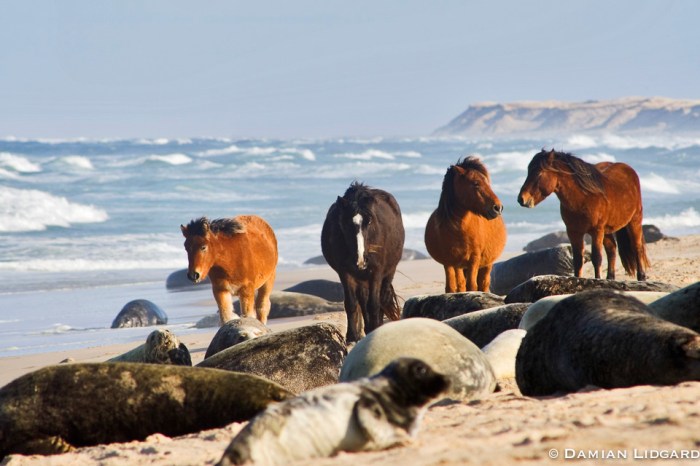
Sable Island is a small island situated 300 km (190 mi) southeast of Halifax, Nova Scotia, and about 175 km (109 mi) southeast of the closest point of mainland Nova Scotia in the Atlantic Ocean. The island is staffed year round by four federal government staff, rising during summer months when research projects and tourism increase. Notable for the Sable Island horse, the island is protected and managed by Parks Canada, which must first grant permission before anyone may visit. Sable Island is part of District 7 of the Halifax Regional Municipality in Nova Scotia. However, the Constitution of Canada specifically names the island as being under the authority of the federal government. The island is also a protected National Park Reserve.
The island is home to over 550 free-roaming horses, protected by law from human interference. This feral horse population is likely descended from horses confiscated from Acadians during the Great Expulsion and left on the island by Thomas Hancock, Boston merchant and uncle of John Hancock. In 1879, 500 horses and cattle were estimated to live on the island, and the island vegetation was described as covered with grass and wild peas. In the past, excess horses were rounded up, shipped off the island, and sold, many used in coal mines on Cape Breton Island, Nova Scotia. In 1960, the Canadian Government, under the Canada Shipping Act, gave the horse population full protection from human interference.
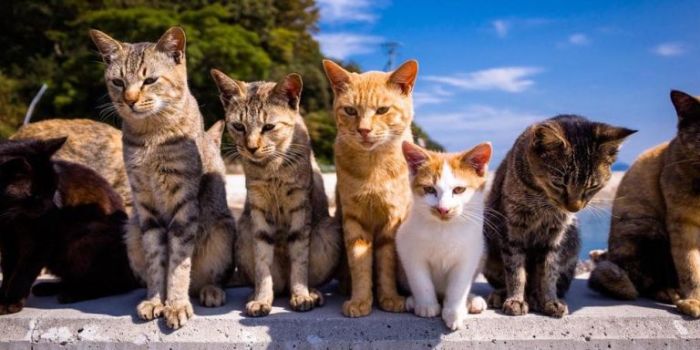
Tashirojima (田代島) is a small island in Ishinomaki, Miyagi Prefecture, Japan. It lies in the Pacific Ocean off the Oshika Peninsula, to the west of Ajishima. It is an inhabited island, although the population is quite small (around 100 people, compared to around 1000 people in the 1950s). It has become known as “Cat Island” due to the large stray cat population that thrives as a result of the local belief that feeding cats will bring wealth and good fortune. The cat population is now larger than the human population on the island. There are no pet dogs on the island due to the large cat population.
The island is divided into two villages/ports: Oodomari and Nitoda. Ajishima, a neighbouring island, used to belong to the town of Oshika, while Tashirojima was a part of the city of Ishinomaki. On April 1, 2005, Oshika merged with Ishinomaki,so now both islands are a part of Ishinomaki.
Since 83% of the population is classified as elderly, the island’s villages have been designated as a “terminal village” which means that with 50% or more of the population being over 65 years of age, the survival of the villages is threatened. The majority of the people who live on the island are involved either in fishing or hospitality.
The island is also known as Manga Island, as Shotaro Ishinomori planned to move to the island. There are manga-themed lodges on the island, resembling cats.
Ōkunoshima (大久野島) is a small island located in the Inland Sea of Japan in the city of Takehara, Hiroshima Prefecture. It is accessible by ferry from Tadanoumi and Ōmishima. There are campsites, walking trails and places of historical interest on the island. It is often called Usagi Shima (うさぎ島, “Rabbit Island”) because of the numerous feral rabbits that roam the island; they are rather tame and will approach humans.
Ōkunoshima played a key role during World War II as a poison gas factory for much of the chemical warfare that was carried out in China.

Many rabbits live on the island that are descended from rabbits intentionally let loose when the island was developed as a park after World War II. During the war, rabbits were also used in the chemical munitions plant to test the effectiveness of the chemical weapons. Those rabbits were killed when the factory was demolished and are not related to the rabbits currently on the island. Hunting the rabbits is forbidden, and dogs and cats are not allowed on the island.
The ruins of the old forts and the gas factory can be found all over the island; entry is prohibited as it is too dangerous. Since it is part of the Innland Sea National Park system of Japan, there is a resource center and across the way is the museum.
In 2015, the BBC presented a short television series called Pets – Wild at Heart, which featured the behaviours of pets, including the rabbits on the island. The series depicted various tourists coming to feed the rabbits.
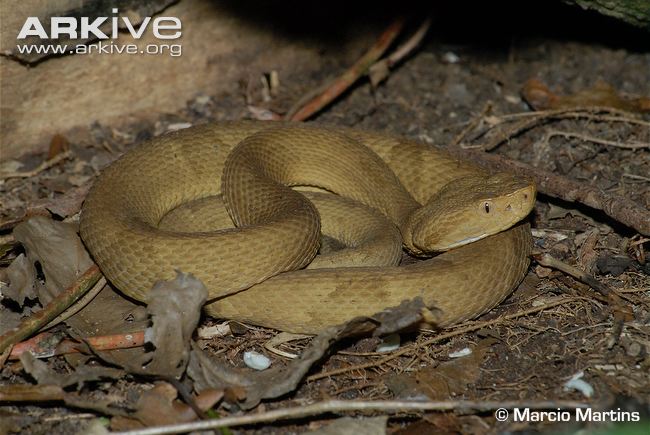
Ilha da Queimada Grande, also known as Snake Island, is an island off the coast of Brazil in the Atlantic Ocean. It is administered as part of the municipality of Peruíbe in the State of São Paulo. The island is small in size and has many different types of terrain, ranging from bare rock to rainforest, and a temperate climate. It is the only home of the critically endangered, venomous Bothrops insularis (golden lancehead pit viper), which has a diet of birds. The snakes became trapped on the island when rising sea levels covered up the land that connected it to the mainland. It has 90,000 snakes on it This left the snakes to adapt to their environment, increasing rapidly in population and rendering the island dangerous to public visitation. Queimada Grande is closed to the public in order to protect this snake population; access is only available to the Brazilian Navy and selected researchers vetted by the Chico Mendes Institute for Biodiversity Conservation, the Brazilian federal conservation unit.
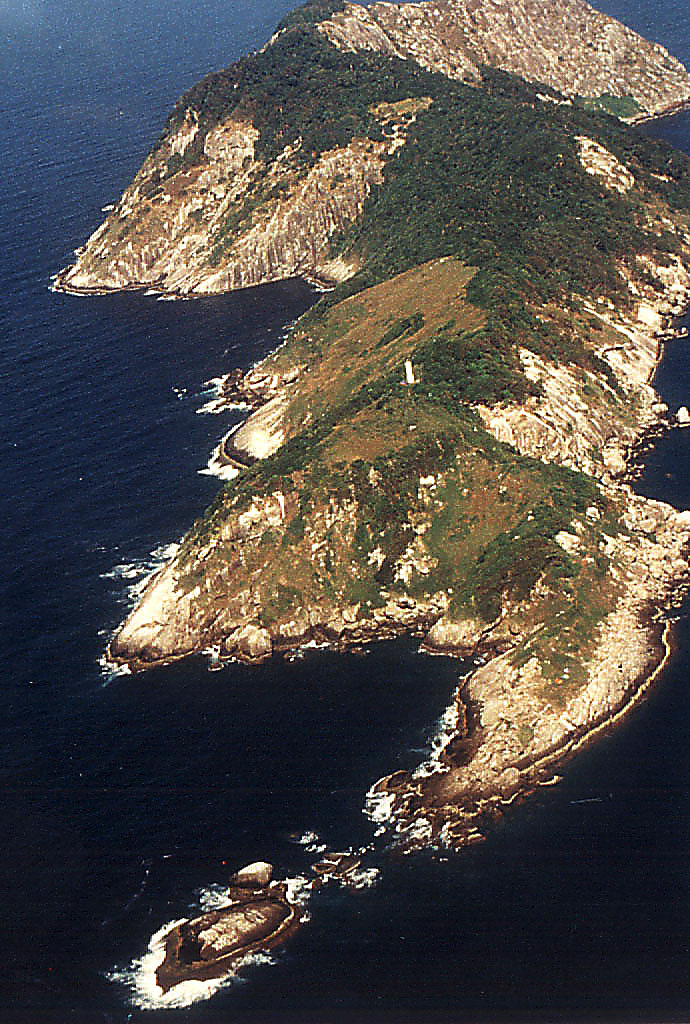
Golden Lancehead pit viper, very very dangerous snake.



















 The MarkoZen Blog