The Dark Hedges

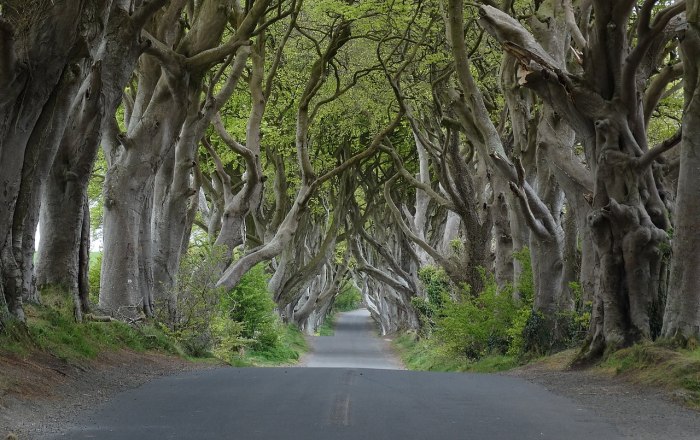
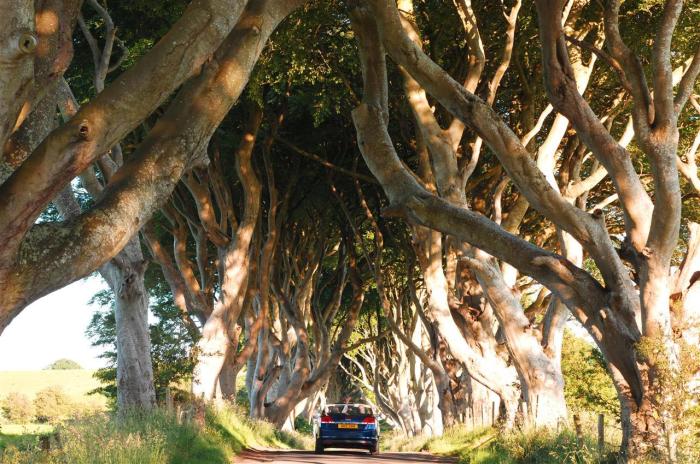
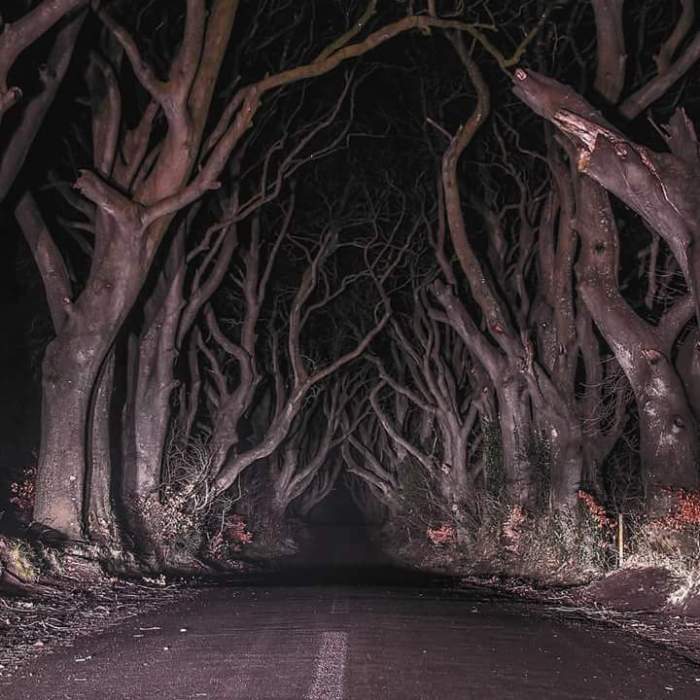
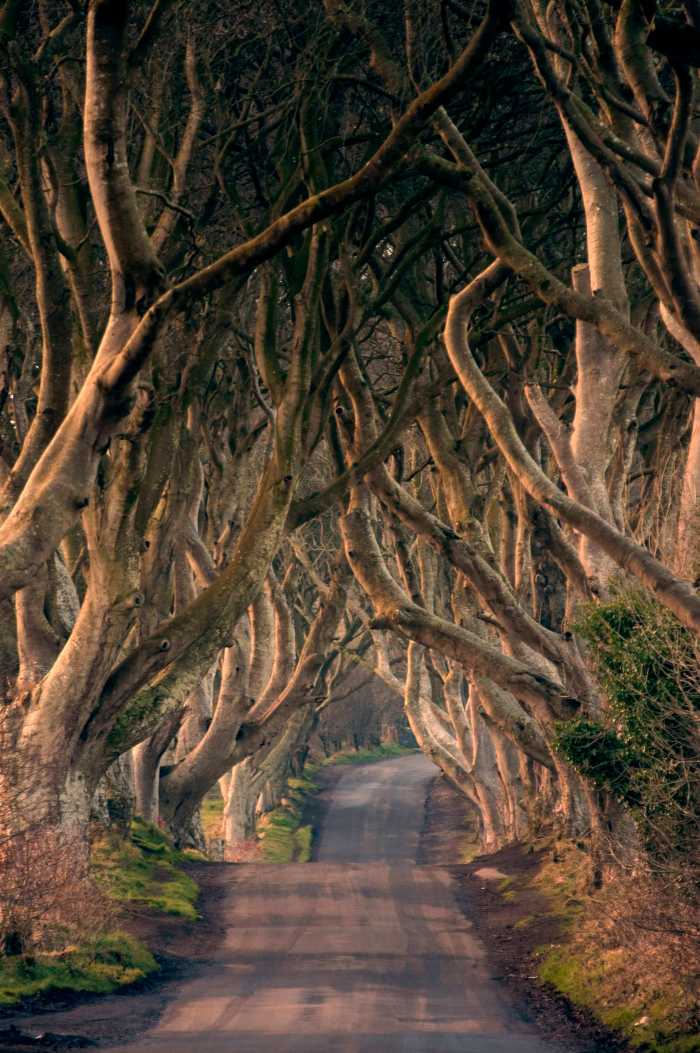
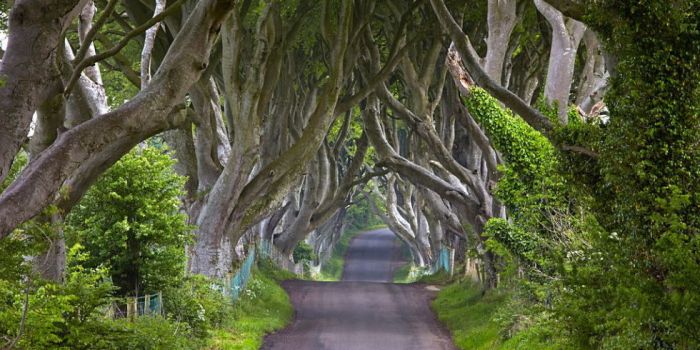
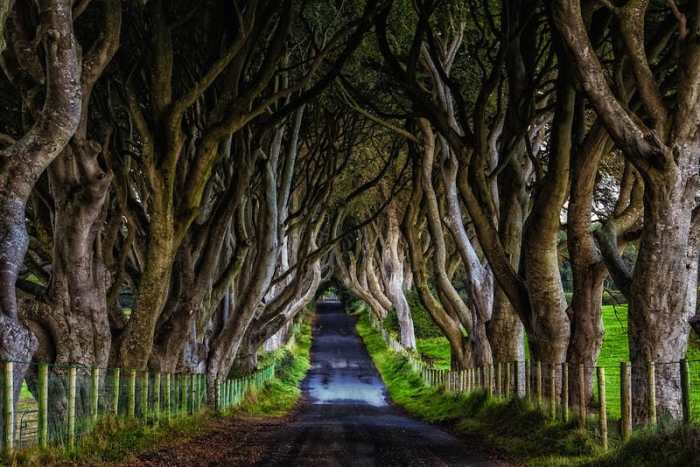
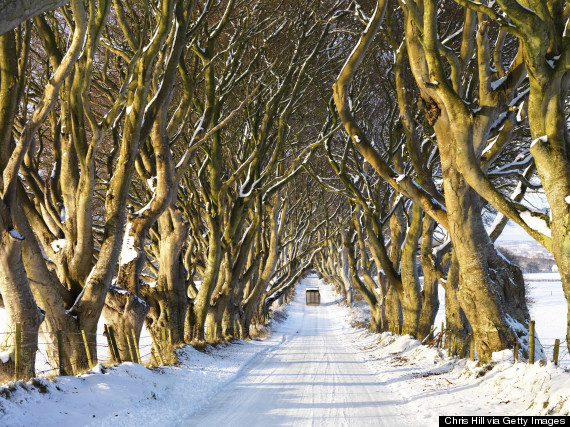
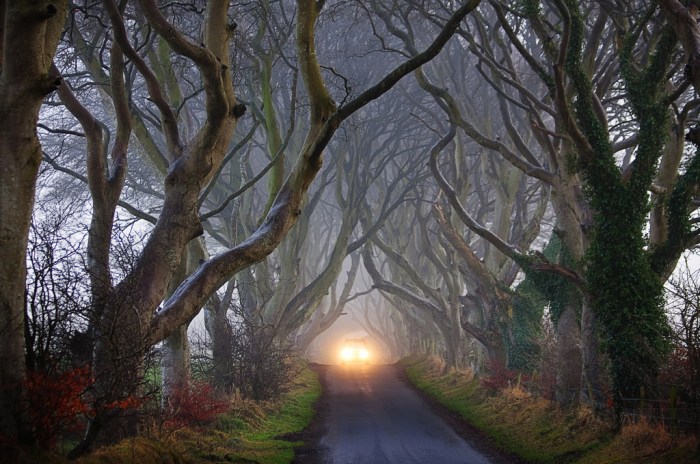
The Dark Hedges is an avenue of beech trees along Bregagh Road between Armoy and Stranocum in County Antrim, Northern Ireland. The trees form an atmospheric tunnel that has been used as a location in HBO’s popular television series Game of Thrones, which has resulted in the avenue becoming a tourist attraction.

dark

In about 1775 James Stuart built a new house, named Gracehill House after his wife Grace Lynd. Over 150 beech trees were planted along the entrance road to the estate, to create an imposing approach.

dark2

According to legend, the hedges are visited by a ghost called the Grey Lady, who travels the road and flits across it from tree to tree. She is claimed to be either the spirit of James Stuart’s daughter (named “Cross Peggy”) or one of the house’s maids who died mysteriously, or a spirit from an abandoned graveyard beneath the fields, who on Halloween is joined on her visitation by other spirits from the graveyard.

hedge

dark4

dark3

The Dark Hedges were used as a filming location for the “King’s Road” in the television series Game of Thrones. The trees have also been used in the 2017 Transformers film The Last Knight.

Dark-Hedges-Ireland

DARK-HEDGES-IRELAND-570

dark-hedges-reland-alley-beautiful2

Trump and the Mexican border

WASHINGTON — Frustrated by Congress’ refusal to provide funds for more than a modest length of border wall, President Donald Trump declared Tuesday that he will deploy U.S. troops to the frontier with Mexico.

army2

He also dramatically scaled back his demand for a barrier along the border, saying he wants a wall along just “700 to 800 miles” — a far cry from what he led supporters to expect.

Militarizing the border would likely escalate tensions with Mexico, which is in the midst of a presidential campaign in which a leading candidate has vowed to ensure that his country is no longer a “piñata” for foreign powers. Trump has been threatening to scrap NAFTA — both to secure more favorable trade terms, and to pressure Mexico to curb the flow of its own citizens and migrants from Central and South America.

army1

But Trump’s inability to deliver on his signature campaign promise has left backers deflated and the president himself openly flustered. He briefly threatened to veto the $1.3 trillion budget deal over the shortage of wall funds.

Trump vowed throughout the 2016 campaign to build a “big, beautiful wall” along the 1,954-mile U.S.-Mexico border, and his rhetoric was widely regarded as a call for a full-length barrier.

army

About 654 miles of the border is already fenced, so Trump’s new goal represents only a modest expansion. Congress provided $1.6 billion in the recent $1.3 trillion omnibus budget, enough to add 33 miles and for replacement barrier along twice that length.

“We have $1.6 billion, and we’re starting brand-new sections of walls. But we need to have a wall that’s about 800 miles — 700 to 800 miles of the 2,000-mile stretch. We have a lot of natural boundaries,” Trump said at a White House meeting, with Defense Secretary Jim Mattis at his side.

Trump has generally been vague about many miles of barrier he envisions. Last July, he told reporters aboard Air Force One as he flew to Paris that he wants “anywhere from 700 to 900 miles of see-through wall.” The remarks were initially off the record but the White House later agreed to release them.

Trump’s Delusion

wall11

wall11a

dumper5

Offbeat News

Luxury ride for stolen livestock in Uzbekistan

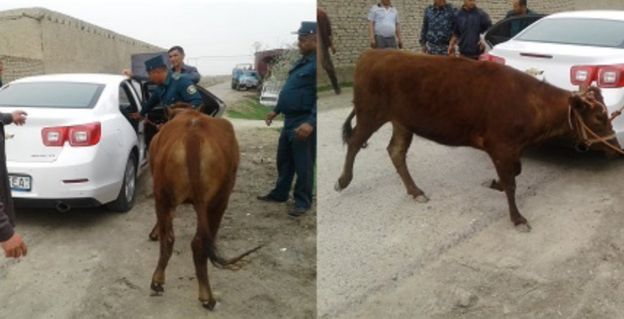
A cow looking out of the back window of a Malibu Chevrolet car

Police in Uzbekistan have apprehended two men for stealing livestock after catching them red-handed with a calf in the back of an expensive car.

Officers in Uzbekistan’s Bukhara region were investigating a report from villagers who had lost a cow and a sheep, and managed to track down two suspects, the UzNews website says.

In order to avoid suspicion, they had been transporting stolen sheep and cattle – even bulls – in a Malibu Chevrolet owned by one of the men, regional police said.


The American brand is a popular one in Uzbekistan where parent company General Motors have a factory – so much so that in 2013, the chance to put a down payment on a car sparked a small stampede.

It is easier to buy a Chevrolet these days, but a Malibu is still a luxury ride.

It is the most expensive of locally produced cars made by the country’s monopolist GM Uzbekistan and costs about about 30,000 dollars – a hundred times the average monthly wage there.

The story has tickled Uzbeks reading about it on social media. “A least the cow looks happy,” one Facebook user says. “Of course, it was stolen in a Malibu car, like a bride,” jokes another.

Police remove the stolen cow from the car Local police have a beef with two suspects over an alleged stolen cow

NZ seniors’ group hits back at ‘elderly driver’ plates

plate

A New Zealand lobby group for senior citizens has criticised a company for selling special plates for cars telling road users that the driver is elderly.

The so-called “E-plates” are being sold by Auckland-based company SafeGrannies as a weapon against road rage, the Stuff.co.nz news website reports.

“A large percentage of road rage could be removed if [drivers] were aware who was in front of them,” says company founder Nick Carrol, pointing out that the signs have similar intentions to ‘baby on board’ signs used by parents in encouraging other drivers to slow down.

But the Grey Power lobby group for over-50s says the NZ$12 (US$9; £6) signs are “ageist”. Its president Tom O’Connor says that he suspects they will do nothing for “the conduct of idiots on the roads”.

“I’ve got no objection if someone wants to put one on their car, but I don’t believe it would help in terms of safety,” he says.

No substitute for experience
Mr Carrol, however, says that his plates have received widespread support from the local elderly community, and claims that senior citizens are safer drivers than young men.

“Older drivers are actually the ones sticking to the speed limit, and in Auckland, that’s not fast enough for other drivers,” he told Stuff.

His claim is backed up by Insurance Brokers Association of New Zealand (IBANZ), which said in 2016 that 18-25 year-old men are the highest risk group of drivers.

IBANZ chief executive Gary Young said at the time that “young males under 25 are diabolical drivers and tend to have the most accidents.

“They think they’re bulletproof, especially those that have just got their licence.”

BBC

As The White House Turns

Counselor to the president Kellyanne Conway claimed Monday that she has a “great relationship” with Ivanka Trump and Jared Kushner, the president’s family members and close advisers, disputing an assertion from the author of a forthcoming book that she is the “number one leaker” in the White House.

“I have a great working relationship and a great relationship with Jared and Ivanka, had dinner with them recently at their house,” Conway said Monday morning, telling Fox News’s “Fox & Friends” that she had discussed the issue briefly on Sunday with President Donald Trump. “He knows, and he has said publicly and privately who the leakers and the liars are and have been. Very happy that there’s a lot less leaking in the White House now than there was.

those who have “survived a lot of people and continue to be here” inspire “a lot of jealously and backbiting.”

kellyanne

She also seemingly reveled in her continued role with the Trump administration while others have departed, telling Fox News reporter Abby Huntsman that those who have “survived a lot of people and continue to be here” inspire “a lot of jealously and backbiting.” Without naming names, she attacked administration leakers and suggested those who have been the loudest in their complaints about the media have also been among the most prolific sources for political reporters. Conway also warned that she will someday have her own story to tell.

“He knows, and he has said publicly and privately who the leakers and the liars are and have been. Very happy that there’s a lot less leaking in the White House now than there was.”

politico.com

Jerusalem Syndrome

Jerusalem syndrome is a group of mental phenomena involving the presence of either religiously themed obsessive ideas, delusions or other psychosis-like experiences that are triggered by a visit to the city of Jerusalem. It is not endemic to one single religion or denomination but has affected Jews, Christians, and Muslims of many different backgrounds.

The best known, although not the most prevalent, manifestation of Jerusalem syndrome is the phenomenon whereby a person who seems previously balanced and devoid of any signs of psychopathology becomes psychotic after arriving in Jerusalem. The psychosis is characterised by an intense religious theme and typically resolves to full recovery after a few weeks or after being removed from the area. The religious focus of Jerusalem syndrome distinguishes it from other phenomena, such as Stendhal syndrome in Florence or Paris syndrome for Japanese tourists.
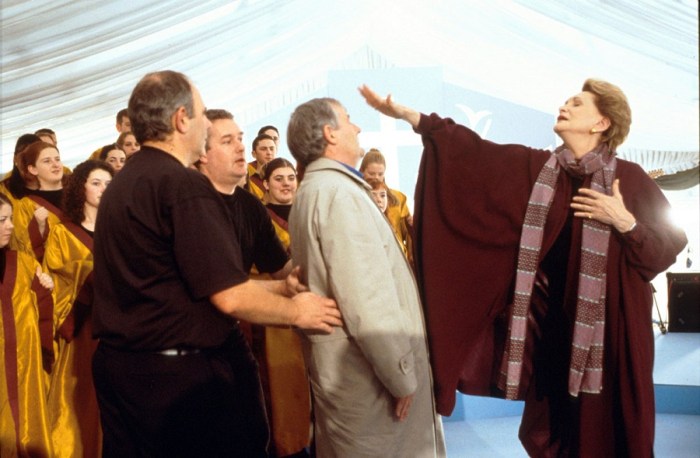
frenzy

In a 2000 article in the British Journal of Psychiatry, Bar-El et al. claim to have identified and described a specific syndrome which emerges in tourists with no previous psychiatric history. However, this claim has been disputed by M. Kalian and E. Witztum. Kalian and Witztum stressed that nearly all of the tourists who demonstrated the described behaviours were mentally ill prior to their arrival in Jerusalem. They further noted that, of the small proportion of tourists alleged to have exhibited spontaneous psychosis after arrival in Jerusalem, Bar-El et al. had presented no evidence that the tourists had been well prior to their arrival in the city. Jerusalem syndrome is not listed or mentioned in the DSM nor in the ICD.

Jerusalem syndrome has previously been regarded as a form of hysteria, referred to as “Jerusalem squabble poison”, or “fièvre Jerusalemmiene”. It was first clinically described in the 1930s by Jerusalem psychiatrist Heinz Herman, one of the founders of modern psychiatric research in Israel. Whether or not these behaviors specifically arise from visiting Jerusalem is debated, as similar behaviors have been noted at other places of religious and historical importance such as Mecca and Rome. It is known that cases of the syndrome had already been observed during the Middle Ages, since it was described in the itinerary of Felix Fabri and the biography of Margery Kempe. Other cases were described in the vast literature of visitors to Jerusalem during the 19th century.

The classic Jerusalem syndrome, where a visit to Jerusalem seems to trigger an intense religious psychosis that resolves quickly or on departure, has been a subject of debate in the medical literature. Most of the discussion has centered on whether this definition of the Jerusalem syndrome is a distinct form of psychosis, or simply a re-expression of a previously existing psychotic illness that was not picked up by the medical authorities in Israel.

In response to this, Bar-El et al. classified the syndrome into three major types to reflect the different types of interactions between a visit to Jerusalem and unusual or psychosis-related thought processes. However Kalian and Witztum have objected, saying that Bar-El et al. presented no evidence to justify the detailed typology and prognosis presented and that the types in fact seem to be unrelated rather than different aspects of a syndrome.

Type I
Jerusalem syndrome imposed on a previous psychotic illness. This refers to individuals already diagnosed as having a psychotic illness before their visit to Jerusalem. They have typically gone to the city because of the influence of religious ideas, often with a goal or mission in mind that they believe needs to be completed on arrival or during their stay. For example, an affected person may believe himself to be an important historical religious figure or may be influenced by important religious ideas or concepts (such as causing the coming of the Messiah or the second coming of Christ).

Type II
Jerusalem syndrome superimposed on and complicated by idiosyncratic ideas. This does not necessarily take the form of mental illness and may simply be a culturally anomalous obsession with the significance of Jerusalem, either as an individual, or as part of a small religious group with idiosyncratic spiritual beliefs.

Type III
Jerusalem syndrome as a discrete form, uncompounded by previous mental illness. This describes the best-known type, whereby a previously mentally balanced person becomes psychotic after arriving in Jerusalem. The psychosis is characterised by an intense religious character and typically resolves to full recovery after a few weeks or after being removed from the locality. It shares some features with the diagnostic category of a “brief psychotic episode”, although a distinct pattern of behaviors has been noted.

Anxiety, agitation, nervousness and tension, plus other unspecified reactions.
Declaration of the desire to split away from the group or the family and to tour Jerusalem alone. Tour guides aware of the Jerusalem syndrome and of the significance of such declarations may at this point refer the tourist to an institution for psychiatric evaluation in an attempt to preempt the subsequent stages of the syndrome. If unattended, these stages are usually unavoidable.
A need to be clean and pure: obsession with taking baths and showers; compulsive fingernail and toenail cutting.
Preparation, often with the aid of hotel bed-linen, of a long, ankle-length, toga-like gown, which is always white.
The need to shout psalms or verses from the Bible, or to sing hymns or spirituals loudly. Manifestations of this type serve as a warning to hotel personnel and tourist guides, who should then attempt to have the tourist taken for professional treatment. Failing this, the two last stages will develop.
A procession or march to one of Jerusalem’s holy places, ex:The Western Wall.
Delivery of a sermon in a holy place. The sermon is typically based on a plea to humankind to adopt a more wholesome, moral, simple way of life. Such sermons are typically ill-prepared and disjointed.
Paranoid belief that a Jerusalem syndrome agency is after the individual, causing their symptoms of psychosis through poisoning and medicating.
Bar-El et al. reported 42 such cases over a period of 13 years, but in no case were they able to actually confirm that the condition was temporary.
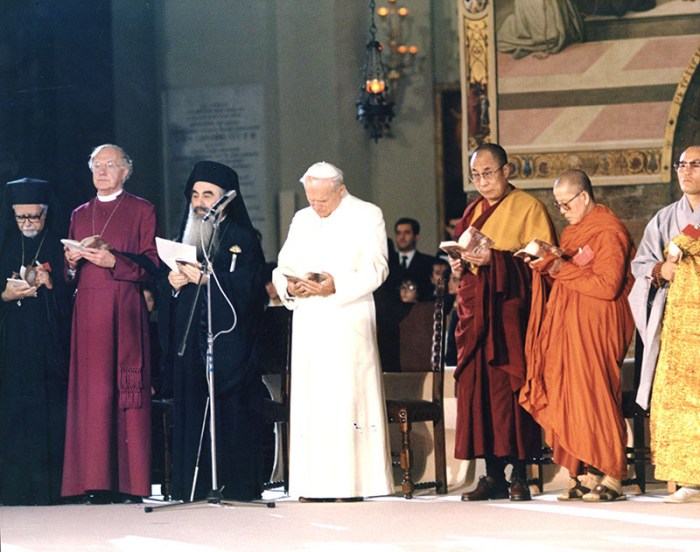
frenzy1

During a period of 13 years (1980–1993) for which admissions to the Kfar Shaul Mental Health Centre in Jerusalem were analysed, it was reported that 1,200 tourists with severe, Jerusalem-themed mental problems were referred to this clinic. Of these, 470 were admitted to hospital. On average, 100 such tourists have been seen annually, 40 of them requiring admission to hospital. About three and a half million tourists visit Jerusalem each year. Kalian and Witztum note that as a proportion of the total numbers of tourists visiting the city, this is not significantly different from any other city.

Wikipedia and Google