Awesome Iceberg brings tourists to tiny Newfoundland town

iceberg

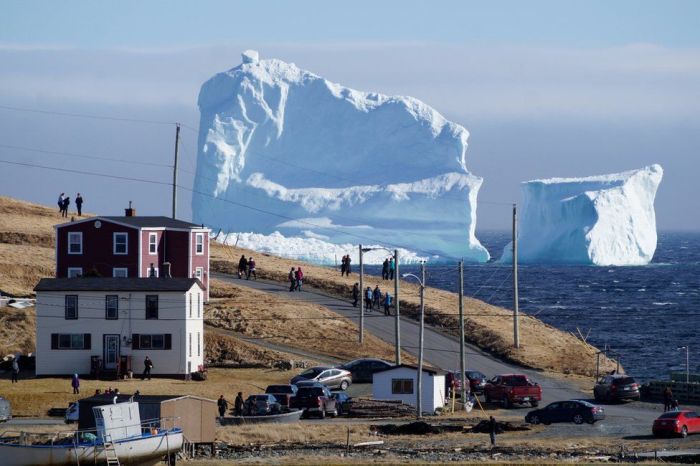
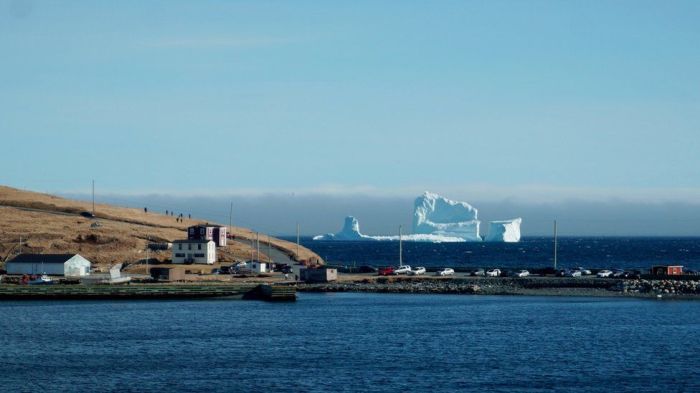
A new natural attraction drew scores of tourists to a small town of around 500 people in Newfoundland, Canada over Easter weekend. A massive iceberg appeared near the coast, and photographers dashed to the area to snap pictures.
The Southern shore highway close to Ferryland filled with traffic over the weekend as tourists came to view the impressive iceberg. The Newfoundland coast area is commonly called iceberg alley due to the ice blocks that float down during the spring from the Arctic, but this particular huge iceberg might stay right where it is, according to Ferryland Mayor Adrian Kavanagh, who told The Canadian Press it’s the biggest one he’s ever seen in the area.

iceberg1

Usually just the tip of an iceberg is visible, with the rest of the mass beneath the waves, so many run aground when they float near the coast. Local Don Costello told CBC News the iceberg probably won’t be moving unless winds keep blowing because it’s stuck on shallow ground. He estimated the iceberg’s highest point is roughly 150 feet.
The BBC reported more icebergs are drifting through iceberg alley than is normal for this point in the year, with hundreds of icebergs in the Atlantic. This particular iceberg has moved around some and broken apart, but it appears it’ll stick around for a while.

iceberg3

iceberg2

I think the name of the town “Ferryland” should also cause tourism.

The Hottest Cities in the World

Winnipeg can experience sustained heat in the summer. Some days it gets up to +34-35.  But this heat is nothing compared to the cities below.  I doubt everyone in these cities have air conditioning.  The people obviously can take the heat.

At least two cities contend closely for the title of ‘Hottest City in the World’. What city ranks the hottest depends on how you look at the temperatures.  Here we compare the world’s most sweltering cities in terms of highest temperatures, hottest nights, and most days of extreme heat. So you can judge which is the World’s Hottest City.

In the world’s hottest cities, temperatures get above 40 degrees Celsius (104 degrees Fahrenheit) nearly every day for months at a time. Dozens of cities in the Middle East and Africa have extended periods of 40-degree weather.  It’s in deserts along the Persian Gulf, on the Arabian Peninsula and in Iraq and Iran, where cities have exceptionally searing summers. In two cities here, the heat rises above the rest. Only Kuwait City and Ahwaz report having months with daily maximum temperatures averaging above 46 °C (115 °F).

Kuwait City lies on the coast near the head of the Persian Gulf. Capital of the tiny country of Kuwait, the city itself houses just over 30 thousand people, but it adjoins other cities that together form a large metropolitan area extending into the desert.

Kuwait City

Ahwaz, also spelled Ahvaz, sprouts from the desert of western Iran with a population of close to a million.  Although inland from the Persian Gulf, Ahwaz sits at just 23 metres (75 feet) above sea level.

The only cities that come close to the regular 46-degree temperatures of Kuwait City and Ahwaz lie roughly between the two cities. In southern Iraq, maximum temperatures average 44.8 °C (112.6 °F) in July and August at An Nasiriya, while Al Amarah has average highs of 45.5 °C (113.9 °F) in July and 44.9 °C (112.8 °F) in August.

Ahwaz, Iran

How Hot is That?

A 46 °C climate is so hot that it’s well beyond the hottest weather ever experienced in many other countries. Forty-six Celsius tops by a degree ( 1.8 degrees F) Canada’s record high temperature and is 7.5 degrees C (13.5 degrees F) warmer than the hottest day in the United Kingdom. Temperatures that would break records in some counties are normal weather, day after day, for several months a year in the world’s hottest cities.

The only place in the United States with 46-degree heat is North America’s hottest spot, Death Valley in eastern California. Summer temperatures at Death Valley soar to average highs of 46.5 °C (115.7 °F) in July and 45.4 °C (113.8 °F) in August.

Death Valley, California

 Highest Daily Temperatures

Ahwaz and Kuwait are nearly equal in their average maximum temperatures during the year’s two hottest months. For both cities in July, highs average 46.7°C (116.1 °F).

Most Extreme Heat

Despite Kuwait City having a marginally greater average, Ahwaz leads the way in extreme temperatures. Several times Ahwaz has achieved temperatures higher than those ever recorded in Kuwait City.

From 1970 to 2000, Ahwaz made it to 52 °C (125.6 °F) or more on three days. Ahwaz had a high of 52.0 on July 12, 1971 and 52.2 °C (126 °F) on July 1, 2000. Neither of those broke any temperature records for the city, since it had already reached 54.0 °C (129.2 °F) on July 15, 1967.

Meanwhile, 52 °C has never been officially documented, as of 2010, in Kuwait City.

City With the Hottest Nights

In most hot cities when daytime temperatures top 40 °C, it usually cools down at night to the mid-20s. Just a few cities have a month of nighttime lows that stay above 30 °C (86 °F), and Kuwait City is one.

During the hottest months of the year, Ahwaz at night normally gets about a degree Celsius cooler than Kuwait City. But the Kuwaiti nights are not the warmest among cities.

Even hotter nights occur in Oman, a country located south of Kuwait on the Arabian Peninsula. Several cities in Oman stay above 30 °C at night in summer, including Buraimi, Sur and Rustaq, plus the capital, Muscat.  The country’s hottest city that measures weather is Samail, where from June to August nights generally don’t go below 30 degrees. Samail’s hottest nights are in July, which average 31.4 °C (88.5 °F), while the days climb to around 43 °C (109.4 °F).

Average monthly temperatures in °C for Kuwait City, Kuwait (1994-2008)
and Ahwaz, Iran (1994-2005).
Month Kuwait City Ahwaz, Iran
High Low High Low
January 19.5 8.5 18.1 8.9
February 21.8 10.0 20.9 9.8
March 26.9 14.0 25.6 13.4
April 33.9 19.5 32.8 19.1
May 40.9 25.4 40.2 24.3
June 45.5 28.9 45.0 27.3
July 46.7 30.7 46.7 29.8
August 46.9 29.5 46.8 29.1
September 43.7 26.2 42.7 24.7
October 36.6 21.5 36.4 20.3
November 27.8 14.5 26.6 13.8
December 21.9 9.9 19.7 10.0
Annual 34.3 19.9 33.5 19.2

North Korea: Proof that Insanity is Hereditary

North Korea is the first and only communist totalitarian family dynasty the world has seen.  I wonder what Marx and Lenin would think of this.  Sort of goes against the idea of equality and justice for all.

kim-jong-un-3-comb_1815141i

The Kim dynasty, officially called Mount Paektu Bloodline, is a three-generation lineage of North Korean leadership descending from the country’s first leader, Kim Il-sung, in 1948. Kim came to rule the North after the end of Japanese control in 1945 split the region. He began the Korean War in 1950 in an attempt to reunify the peninsula. Kim developed a cult of personality closely tied to their state philosophy of Juche, which was passed on to his successors: his son Kim Jong-il and grandson Kim Jong-un.
In 2013, Clause 2 of Article 10 of the new edited Ten Fundamental Principles of the Korean Workers’ Party states that the party and revolution must be carried “eternally” by the “Baekdu bloodline”.

kim-family-photo

kimx1


kim2

Kim-Jong-Un-Cartoon2

kimx

Russian anti-alcohol posters from the late Soviet era

1972-1988

Soviet anti-alcohol posters

In Soviet Russia, alcohol consumes YOU!

by Alex Q. Arbuckle

c. 1986

“Little by little, and you end up with a hooligan. Tolerance of drinking is dangerous. There is but a step from drinking to crime.”

From the 1960s through the 1980s, artists throughout the Soviet Union designed propaganda posters to warn the public of the dangers of excessive alcohol consumption.

With striking, colorful graphics and stark metaphors, the posters cast alcoholism as a snake choking the life from vivacious young men, a bottle as a prison, and more.

Drinkers grow slothful and lazy, abandon their families, endanger their coworkers, or become murderous brutes.

1988

“Underpass — to the ‘next world.'”

IMAGE: S. SMIRNOV/ALCOHOL BY FUEL PUBLISHING

1985

“We will overcome!” (Text on snake: “Alcoholism.”)

IMAGE: E. BOR/ALCOHOL BY FUEL PUBLISHING

1972

“Not among trees or grasses, the serpent has warmed up among us. Don’t suck on him, mammals, or you’ll turn into a reptile yourself.”

1977

“Don’t drink your life away.”

IMAGE: I.M. MAISTROVSKY/ALCOHOL BY FUEL PUBLISHING

1987

“His inner world.”

IMAGE: P.D. YEGOROV/ALCOHOL BY FUEL PUBLISHING

1980

“This is a shameful union — a slacker + vodka!”

IMAGE: V.O. PUSHENKO/ALCOHOL BY FUEL PUBLISHING

Very tough trucks indeed

BBC

Five military trucks you can buy … and one you can’t

bbcLand Rover Defender                           

Country of origin: Britain

Briefing: Like the scrappy military transport that would become the Jeep Wrangler, the Land Rover Defender has evolved over its 65-year history, but has never jettisoned an ounce of capability. Available in hard-top, double-cab, pickup and bare-chassis configurations, the Defender is found around the globe, with some 55,000 units in active military service.

Price (Britain, exclusive of VAT): From £21,415 (approximately $34,500)

bbc1Renault Sherpa                           

Country of origin: France

Briefing: Renault’s mighty Sherpa owes its appeal not only to the olive drab versions piloted by French and NATO soldiers, but to the charismatic appearances of the civilian model in the grueling Dakar Rally. Available by special order in Russia, Africa and the Middle East, the non-military Sherpa can be had as an unarmoured station wagon or pickup, or, for war-zone duty, a fully-armoured wagon. Power comes from a deafening 4.76-litre four-cylinder diesel engine. Its 215hp and 590lb-ft of torque reach all four wheels through a six-speed automatic transmission.

Price (UAE): Approximately 1m dirham ($272,000)
gaz-gaz-tiger-006
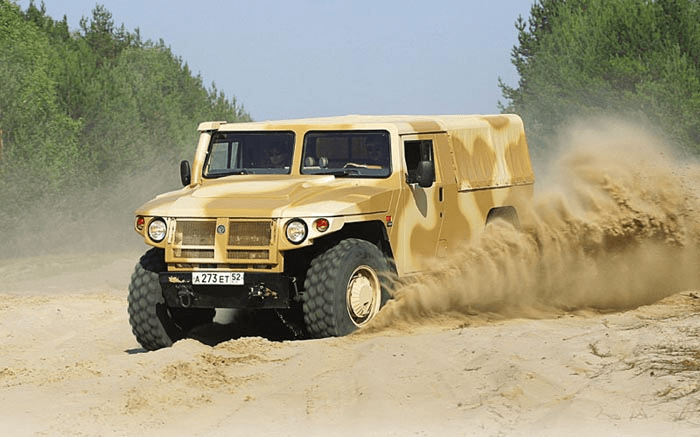
GAZ Tigr                           

Country of origin: Russia

Briefing: That the military Tigr bears a passing resemblance to the American Humvee is, to the Russian truck’s vociferous fans, nothing more than coincidence. Beneath its expansive hood rumbles a 5.9-litre diesel engine, which meets a six-speed manual transmission and permanent four-wheel-drive. Production of the civilian Tigr – which can soften its brutality with the addition of such creature comforts as leather, air conditioning and a thumping audio system – is hardly a top priority for GAZ, and acquiring one is neither simple nor inexpensive, but a successful buyer is fairly guaranteed to be the only Tigr-tamer in his okrestnosti.

Price (Russia): approximately 3.5m rubles ($110,000)

Mercedes-Benz G63 AMG 6x6 Showcar, Dubai 2013Mercedes-Benz G63 AMG 6×6                           

Country of origin: Austria

Briefing: As production vehicles go, the Mercedes-Benz Geländewagen, otherwise known as the G Class, is ancient. Merely revised during more than 30 years of production, this bricklike military machine in a civilian paintjob still manages to capture the imagination of those who dream of traffic parting with their approach – business tycoons, action-film stars, the Pope. Like the “standard” G63 AMG, the new G63 AMG 6×6 packs a twin-turbo 5.5-litre V8 engine producing 536hp and 560lb-ft of torque. The engine meets the six-by-six drivetrain from Mercedes’ hulking Zetros truck, yielding 15.75in of ground clearance – sufficient to ford water as deep as 40in. Getting behind the wheel of this ultimate G Class, unless you happen to be, say, a James Bond villain, will be tricky. The vehicle is not (legally) destined for North America or right-hand-drive countries, and Mercedes has promised that production volume will be “very small”.

Price (Germany, exclusive of VAT): 379,000 euros (approximately $523,000) VAT- Value Added Tax

Price (Russia): approximately 3.5m rubles ($110,000)

Price (UAE): Approximately 1m dirham ($272,000)

Price (Britain, exclusive of VAT): From £21,415 (approximately $34,500)

bbc4Paramount Marauder                           

Country of origin: South Africa

Briefing: Ten tonnes of South African stoutness, the Marauder is possessed of a double-skin monocoque that helps it resist virtually all forms of light-arms fire, as well as the occasional anti-tank mine. It also, as Top Gear’s Richard Hammond learned,  is rather good as a city runabout – provided the pilot steers clear of fast-food drive-throughs.

Price: $485,000

bbc5Oshkosh L-ATV

Country of origin: United States

Briefing: How to replace a fleet of aging Humvees that numbers in the tens of thousands? With a bit of technological derring-do. Wisconsin-based Oshkosh Defense has developed the L-ATV prototype to pick up where the Humvee has left off, carrying a diesel-electric hybrid powertrain that allows the purpose-built vehicle to run near-silent when missions require it. The US government has taken delivery of 22 L-ATV prototypes for testing, but civilian sales do not figure in Oshkosh’s immediate product plans.

Price: N/A

bbc6

Secret US nuclear bomb videos revealed

The Lawrence Livermore National Laboratory in California has, for the first time, made their archive of approximately 10,000 nuclear testing videos available online.

The footage, much of it from the Cold War era of the 1950s and 60s, has been painstakingly restored after the original films were declassified by the US government.

Video Source: Lawrence Livermore National Laboratory and the Prelinger Archives

BBC

The Mother of All Bombs

The Massive Ordnance Penetrator (MOP) GBU-57A/B is a U.S. Air Force massive, precision-guided, 30,000-pound (13,608 kg) “bunker buster” bomb.  This is substantially larger than the deepest penetrating bunker busters previously available, the 5,000-pound (2,268 kg) GBU-28 and GBU-37.

The U.S. Air Force has no specific military requirement for an ultra-large bomb, but it does have a concept for a collection of massively sized penetrator and blast weapons, the so-called “Big BLU” collection, which includes the MOAB (Massive Ordnance Air Burst) bomb. Development of the MOP is now underway at the Air Force Research Laboratory, Munitions Directorate, Eglin Air Force Base, Florida. Design and testing work is also being performed by Boeing. It is intended that the bomb will be deployed on the B-2 bomber, and will be guided by the use of GPS.


A test release from a B-52 bomber


The push for accelerated deployment is due to the increased perceived nuclear threats from Iran and North Korea. It’s believed that many of their nuclear programs could be in development underground, below levels of current bunker-busting bombs’ range. The Pentagon intends the rapid deployment to send a message that the United States is tweaking strategies to address new threats.


The Air Force took delivery of 20 bombs, designed to be delivered by the B-2 bomber, in September 2011. In February 2012, Congress approved $81.6 million to further develop and improve the weapon.

On 25 June 2010, USAF Lt. Gen. Phillip Breedlove said that the Next-generation Penetrator Munition should be about a third the size of the Massive Ordnance Penetrator so it could be carried by affordable aircraft.  In December 2010, the USAF had a Broad Agency Announcement (BAA) for the Next Generation Penetrator (NGP).

Global Strike Command has indicated that one of the objectives for the Next-Generation Bomber is for it to carry a weapon with the effects of the Massive Ordnance Penetrator. This would either be with the same weapon or a smaller weapon that uses rocket power to reach sufficient speed to match the penetrating power of the larger weapon.


Israel doesn’t have military jets big enough to carry the MOP.  But they have been working on their own penetrators which are much smaller than MOP, and therefore could be carried by Israel’s F-15I Strike Eagles and Jericho missiles.  As one official reported, “You would be surprised at their accuracy” and that the high explosives involved is a special mix of chemical explosives that could conceivably penetrate the Iranian fortifications.