Coffee

cool-coffee-quotes-signs-vintage

cool coffee

cool coffee1

Main exporters by country in 2015/16

Country 60 kilogram bags Metric Tons Pounds
BrazilBrazil 43,200,000 2,592,000 5,714,381,000
VietnamVietnam 27,500,000 1,650,000 3,637,627,000
ColombiaColombia 13,500,000 810,000 1,785,744,000
IndonesiaIndonesia 11,000,000 660,000 1,455,050,000
EthiopiaEthiopia 6,400,000 384,000 846,575,000
HondurasHonduras 5,800,000 348,000 767,208,000
IndiaIndia 5,800,000 348,000 767,208,000
UgandaUganda 4,800,000 288,000 634,931,000
MexicoMexico 3,900,000 234,000 515,881,000
GuatemalaGuatemala 3,400,000 204,000 449,743,000
PeruPeru 3,200,000 192,000 423,287,000
NicaraguaNicaragua 2,200,000 132,000 291,010,000
ChinaChina(2013/14 est.) 1,947,000 116,820 257,544,000
Ivory CoastIvory Coast 1,800,000 108,000 238,099,000
Costa RicaCosta Rica 1,492,000 89,520 197,357,000
KenyaKenya 833,000 49,980 110,187,000
Papua New GuineaPapua New Guinea 800,000 48,000 105,821,000
TanzaniaTanzania 800,000 48,000 105,821,000

coffee


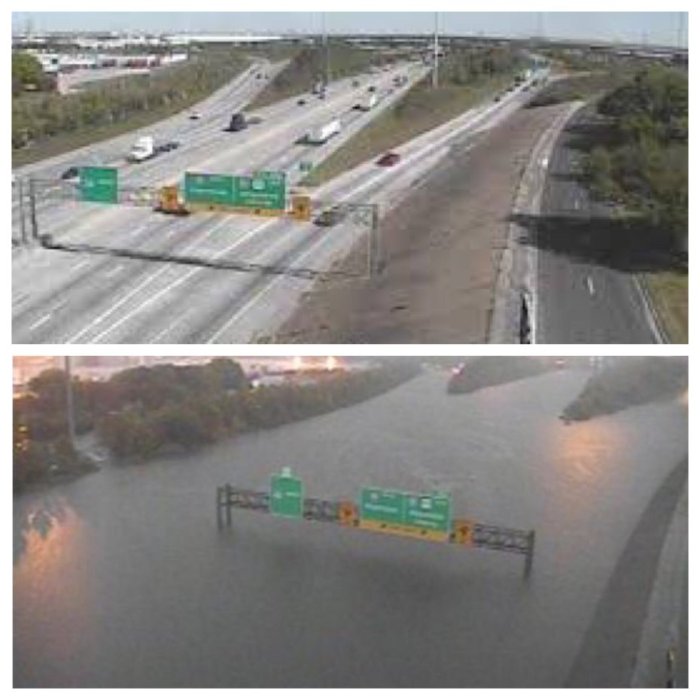
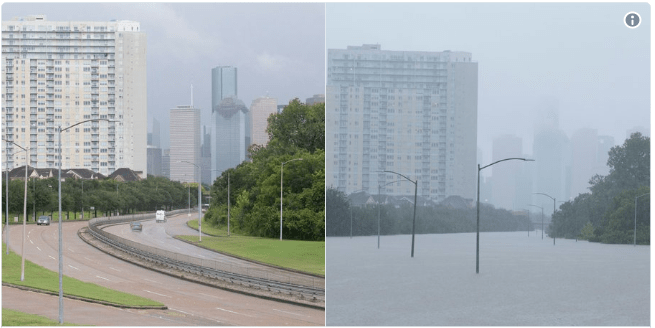
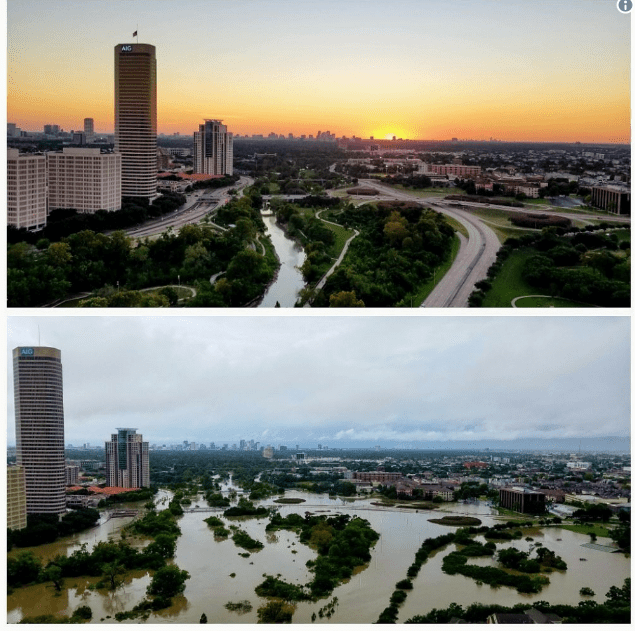
Before and After Photos from Houston

Startling before-and-after images from Houston, where hurricane Harvey dumped a trillion gallons of water after tearing up much of coastal Texas.

At least eight deaths are reported and it’s expected to generate more damage than Katrina. Yet it’s far from over, with no end to the rain. Nearly half a million people will need disaster relief in what is being plainly described as the worst disaster ever to hit in Texas. Some 30,000 people need immediate shelter.

flood1

flood2

flood3

Boingboing.net

Falcons on a Plane

Falconry has been popular for many centuries around the world. Falconry is the use of Falcons to hunt other creatures. It is especially popular in the United Arab Emirates and Qatar in the Middle East.

The sport of falconry began over 5,000 years ago in Iran, and spread over the centuries to East and West. The sport was introduced to Qatar through Bedouin tribes who used the birds as a tool for hunting. They discovered that it was much easier to allow the raptors to take down birds migrating across the Arabian Peninsula than it was to shoot them down themselves. This Bedouin method of falconry set the basis for the modern version of the sport practiced in Qatar.


falco_cherrug_qatar


falcons1-2


Although, over the centuries, falconry has virtually disappeared from the European continent, the sport lives on in the Middle East. In Qatar, you can still purchase falcons in downtown Doha at falcon souqs or through private dealers. The best raptors can cost thousands of dollars and may even be issued their own Qatari passports to ensue they are not stolen or taken out of the country without the owner’s permission. Due to these elaborate methods of theft prevention, it is not uncommon for you to be seated beside a full-grown falcon when travelling on a Middle Eastern airliner.


In a Qatar Airways economy cabin of a flight between Baku, Azerbaijan, and Doha, Qatar, a group of Qatari men sit on the plane with their treasured birds. The men practise the art of falconry and to escape the heat of Qatar flew for a week to the cooler weathers of Azerbaijan to let the birds fly. The birds cost over US$10,000 each, have micro-chips in their legs so they can find them if they fly off and documents allowing them to travel abroad.


falcons-on-a-plane


falcons-on-board


From Airport Guide Traveller:

Live animal facility

All pets travelling via Hamad International Airport enjoy the comfort of our dedicated live animal facility while they wait for their connecting or departing flights. This is a secure and climate-controlled environment that is supervised by trained animal handlers.

Collecting your pet

An airline representative in  the baggage claim area will deliver your pet to you in person. Please contact the Airline Baggage Service office near Belt 1  (map) if you need any assistance. Once you’ve collected the rest of your checked baggage please proceed to Customs where your pet’s travel documents will be inspected.

Things to remember

  • Please inform your airline well in advance to finalize travel arrangements and documentation for your pet.
  • Please make sure your pet is secured in a suitable container and has access to food and water.

Falcons

Some airlines, such as Qatar Airways, will allow your falcon to travel with you in the passenger cabin (only in Economy Class). Other airlines may accept your falcon for travel but only as checked baggage. Before starting your journey please consult your airline for guidance.

An amazing specimen from Kazakhstan:


falconx

The Sand Lakes of Brazil

The Lençóis Maranhenses National Park located in Maranhão state, in northeastern Brazil, is one of the most marvelous and unique places in the world. An area encompassing about 1000 square kilometers of white silky sands intercepted at regular intervals by endless cool oases of turquoise lakes.

At first glance Lençóis Maranhenses looks like an archetypal desert. In fact it isn’t actually a desert just like the Tottori Sand Dunes aren’t. Lying just outside the Amazon basin, the region is subject to a regular rain season during the beginning of the year. The rain water accumulates in the valleys in between sand dunes and forms clear blue and green lagoons that reach their fullest between July and September. The area is also surprisingly home to a variety of fish which, despite the almost complete disappearance of the lagoons during the dry season, have their eggs brought from the sea by birds. Mangroves, deserted beaches, buritis – a graceful kind of palm tree – and the Preguiças River help compose the park’s diversity.


Lençóis Maranhenses has been formed over thousands of years, as the sand from riverbeds is deposited at the mouth of the rivers and brought back to the continent by winds and sea currents.

The dunes advance as far as 31 miles into the continent and stretch along 27 miles of coastline, mostly deserted beaches. Some of the lagoons at Lençóis Maranhenses National Park are huge. Lagoa Bonita and Lagoa Azul are near the town of Barreirinhas. Lagoa Tropical, also worth a visit, is closer to the village of Atins. Lagoa da Gaivota (Seagull Lagoon), one of the park’s largest and most beautiful, is near Santo Amaro do Maranhão, a village located about 60 miles from Barreirinhas.


The best time to visit the park is roughly from May to September, when it’s sunny, yet the lagoons are still full.


Photos, of This and That

Japanese boy soldier prisoners on Okinawa WWII. One said he was 21 years old and the other one said he was 18.


red pics jap prisoners okinawa


Greek village


red greek village


Niagara Falls


red niagara falls


Antarctica from space


red


Fish Tank?


red4

Bridges in Winnipeg


red6a


Trains crossing a bridge that carries the CN Rail mainline through Winnipeg.


Young lady skateboarder Winnipeg. I think chick skateboarders are really cool.


red6c


Condo in Winnipeg with a different design. Locally known as the UFO building.

red6b


Palestinian girl shaking hands with an Israeli soldier.


red5


Storm brewing over Cleveland


red7 Cleveland


A museum that wants to scare the crap out of visitors?


red6


Canada’s Andre Degrasse and Jamaica’s Usain Bolt sharing smiles in the 200 meter semi-final as they crossed the finish line together.


bolt


Very big trees along the Red River in Winnipeg.


red6d


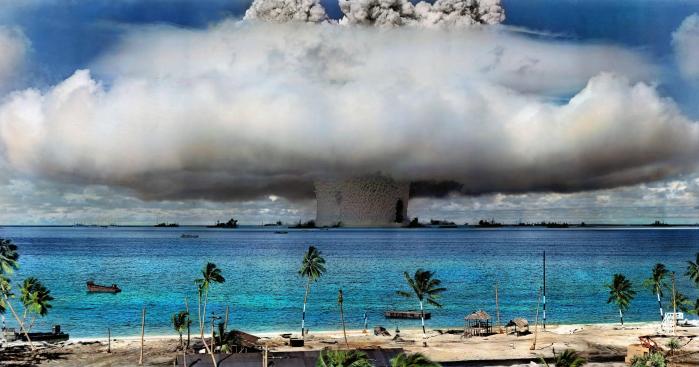
FEMA’s information on a Nuclear Blast

Federal Emergency Management Agency
cave11

Nuclear Blast

A nuclear blast is an explosion with intense light and heat, a damaging pressure wave, and widespread radioactive material that can contaminate the air, water, and ground surfaces for miles around. A nuclear device can range from a weapon carried by an intercontinental missile, to a small portable nuclear device transported by an individual. All nuclear devices cause deadly effects when exploded.

Hazards of Nuclear Devices

The danger of a massive strategic nuclear attack on the United States is predicted by experts to be less likely today. However, terrorism, by nature, is unpredictable.

In general, potential targets include

  • Strategic missile sites and military bases.
  • Centers of government such as Washington, DC, and state capitals.
  • Important transportation and communication centers.
  • Manufacturing, industrial, technology, and financial centers.
  • Petroleum refineries, electrical power plants, and chemical plants.
  • Major ports and airfields.

The three factors for protecting oneself from radiation and fallout are distance, shielding and time.

  • Distance – the more distance between you and the fallout particles, the better. An underground area such as a home or office building basement offers more protection than the first floor of a building. Shielding – the heavier and denser the materials – thick walls, concrete, bricks, books and earth – between you and the fallout particles, the better.
  • Time – fallout radiation loses its intensity fairly rapidly. In time, you will be able to leave the fallout shelter. Radioactive fallout poses the greatest threat to people during the first two weeks, by which time it has declined to about 1 percent of its initial radiation level.

Taking shelter during a nuclear blast is absolutely necessary. There are two kinds of shelters:

  • Blast shelters are specifically constructed to offer some protection against blast pressure, initial radiation, heat and fire. But even a blast shelter cannot withstand a direct hit from a nuclear explosion.
  • Fallout shelters do not need to be specially constructed for protecting against fallout. They can be any protected space, provided that the walls and roof are thick and dense enough to absorb the radiation given off by fallout particles.

Remember that any protection, however temporary, is better than none at all, and the more shielding, distance and time you can take advantage of, the better.

Before a Nuclear Blast

The following are things you can do to protect yourself, your family and your property in the event of a nuclear blast.

  • Build an Emergency Supply Kit
  • Make a Family Emergency Plan.
  • Find out from officials if any public buildings in your community have been designated as fallout shelters.
  • If your community has no designated fallout shelters, make a list of potential shelters near your home, workplace and school, such as basements, subways, tunnels, or the windowless center area of middle floors in a high-rise building.
  • During periods of heightened threat increase your disaster supplies to be adequate for up to two weeks.

During a Nuclear Blast

The following are guidelines for what to do in the event of a nuclear explosion.

  • Listen for official information and follow the instructions provided by emergency response personnel.
  • If an attack warning is issued, take cover as quickly as you can, below ground if possible, and stay there until instructed to do otherwise.
  • Find the nearest building, preferably built of brick or concrete, and go inside to avoid any radioactive material outside.
  • If better shelter, such as a multi-story building or basement can be reached within a few minutes, go there immediately.
  • Go as far below ground as possible or in the center of a tall building.
  • During the time with the highest radiation levels it is safest to stay inside, sheltered away from the radioactive material outside.
  • Radiation levels are extremely dangerous after a nuclear detonation but the levels reduce rapidly.
  • Expect to stay inside for at least 24 hours unless told otherwise by authorities.
  • When evacuating is in your best interest, you will be instructed to do so. All available methods of communication will be used to provide news and / or instructions.

If you are caught outside and unable to get inside immediately:

  • Do not look at the flash or fireball – it can blind you.
  • Take cover behind anything that might offer protection.
  • Lie flat on the ground and cover your head. If the explosion is some distance away, it could take 30 seconds or more for the blast wave to hit.
  • Take shelter as soon as you can, even if you are many miles from ground zero where the attack occurred – radioactive fallout can be carried by the winds for hundreds of miles.
  • If you were outside during or after the blast, get clean as soon as possible, to remove radioactive material that may have settled on your body.
  • Remove your clothing to keep radioactive material from spreading. Removing the outer layer of clothing can remove up to 90% of radioactive material.
  • If practical, place your contaminated clothing in a plastic bag and seal or tie the bag. Place the bag as far away as possible from humans and animals so that the radiation it gives off does not affect others.
  • When possible, take a shower with lots of soap and water to help remove radioactive contamination. Do not scrub or scratch the skin.
  • Wash your hair with shampoo or soap and water. Do not use conditioner in your hair because it will bind radioactive material to your hair, keeping it from rinsing out easily.
  • Gently blow your nose and wipe your eyelids and eyelashes with a clean wet cloth. Gently wipe your ears.
  • If you cannot shower, use a wipe or clean wet cloth to wipe your skin that was not covered by clothing.

After a Nuclear Blast

People in most of the areas that would be affected could be allowed to come out of shelter within a few days and, if necessary, evacuate to unaffected areas. The heaviest fallout would be limited to the area at or downwind from the explosion. It might be necessary for those in the areas with highest radiation levels to shelter for up to a month.

Returning to Your Home

Remember the following when returning home:

  • Keep listening to the radio and television for news about what to do, where to go and places to avoid.
  • Stay away from damaged areas. Stay away from areas marked “radiation hazard” or “HAZMAT.”

Trump’s “Great Great Wall” may have to be downsized

First Trump bellowed that Mexico will pay for the wall. At his rally’s he would say ” who’s going to pay for the wall!”, his minions would chant, Mexico! Mexico! Then after the crowd of rednecks were fed up with that chant, they would revert back to their favourite chant, “Lock her up, lock her up”.

What made Trump think that Mexico was going to pay for the wall is still a Great mystery. He had no legal basis for making such a claim.

Fast forward, now ‘The Donald’ is threatening to shut down the federal government if Congress doesn’t fund his wall. Estimates put the cost of the wall at anywhere between 10 and 20 billion dollars.  Congress will not be enthusiastic about funding the Trump Wall.

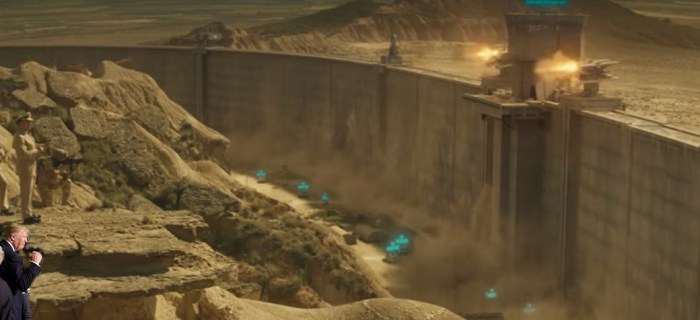
In the warped mind of Trump this is the walls he envisioned:

wall11

A hundred feet high manned by remote anti-tank missiles and laser beams.

wall11a

With Apache helicopter gunships patrolling the wall, prepared to open up on any rapist illegal Mexicans that venture near the wall.

wallxxxx

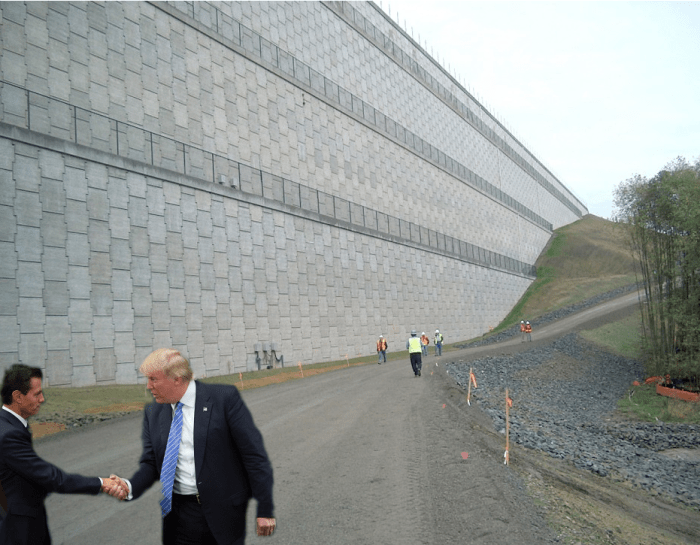
Trump having another fantasy dream with another great wall while the Mexican president agrees to pay.  He thinks of himself as such a great deal maker.

trump-wall_zpsv2s0ihvb

Trump having another wall wet dream.

Ultimately, Trump won’t get federal funding for the wall. He will have to pay for it with his own money. A downsize will happen because Trump doesn’t want to have to declare bankruptcy again. Even Trump can’t afford the “Great Wall”.

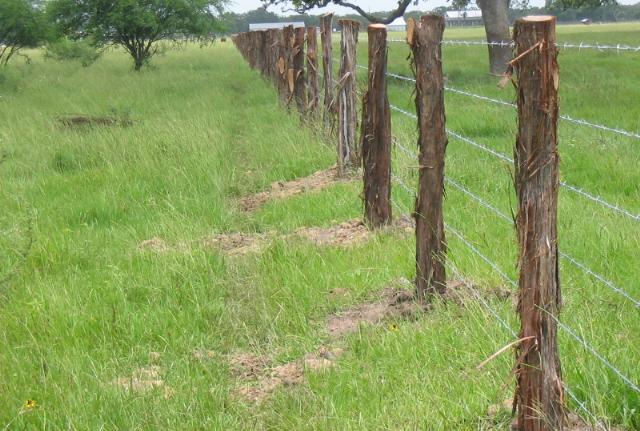
The downsized wall:

Bi_Barbed_Wire_Fence

Or maybe something like this

bi1

At least it will keep out illegal Mexican Donkeys.