Ozzie does a great job
1969
Ozzie does a great job
1969
The Chemosphere is a strange looking house located in the San Fernando Valley area of Los Angeles. It was built in 1960 by by American architect John Lautner. It is a one story octagon with around 2200 square feet (200m2) of living space. Most distinctively, the house is perched atop a concrete pole nearly thirty feet high. This innovative design was Lautner’s solution to a site that, with a slope of 45 degrees, was thought to be practically unbuildable. Access is by a long stairway and a cable railway.
Because of a concrete pedestal, almost 20 feet (6.1 m) in diameter, buried under the earth and supporting the post, the house has survived earthquakes and heavy rains.
The building was first used in a dramatic film as a futuristic residence in the 1964 ABC-TV program “The Outer Limits: The Duplicate Man,” based on a science fiction story by American author Clifford D. Simak. Exterior scenes for the television episode were shot on location; a detailed sound-stage set of the house’s interior was built.


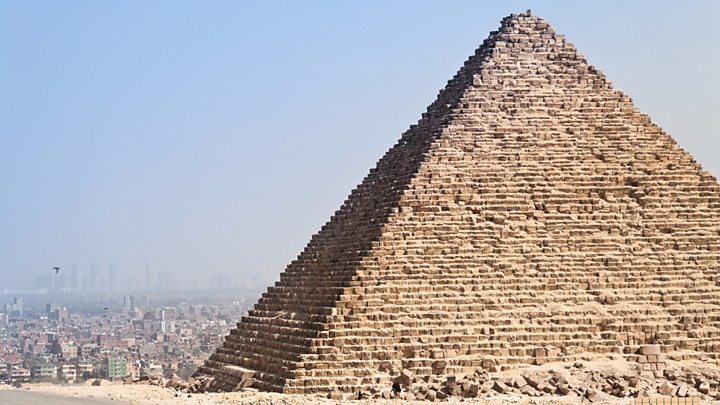
The mysteries of the pyramids have deepened with the discovery of what appears to be a giant void within the Khufu, or Cheops, monument in Egypt.
It is not known why the cavity exists or indeed if it holds anything of value because it is not obviously accessible.
Japanese and French scientists made the announcement after two years of study at the famous pyramid complex.
They have been using a technique called muography, which can sense density changes inside large rock structures.
The Great Pyramid, or Khufu’s Pyramid, was constructed during the reign of Pharaoh Khufu between 2509 and 2483 BC.
At 140m (460 feet) in height, it is the largest of the Egyptian pyramids located at Giza on the outskirts of Cairo.
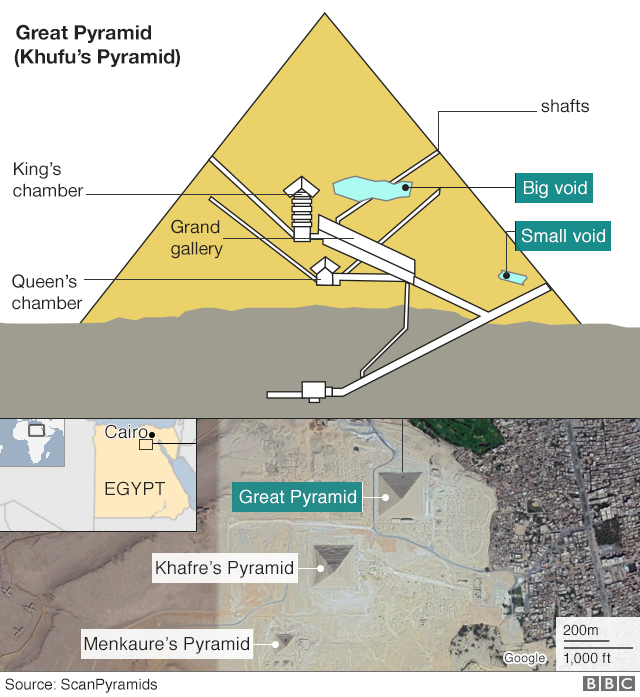

Khufu famously contains three large interior chambers and a series of passageways, the most striking of which is the 47m-long, 8m-high Grand Gallery.
The newly identified feature is said to sit directly above this and have similar dimensions.
“We don’t know whether this big void is horizontal or inclined; we don’t know if this void is made by one structure or several successive structures,” explained Mehdi Tayoubi from the HIP Institute, Paris.
“What we are sure about is that this big void is there; that it is impressive; and that it was not expected as far as I know by any sort of theory.”
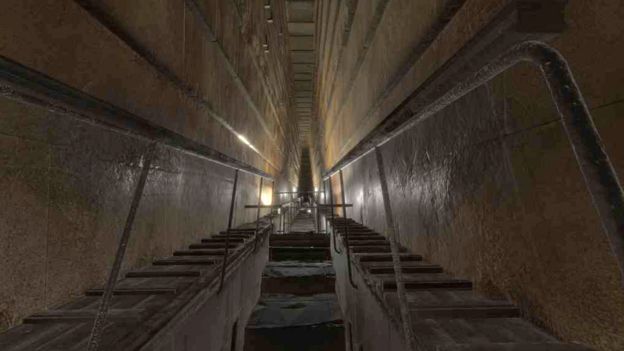 Image copyrightSCANPYRAMIDS
The Scan pyramids team is being very careful not to describe the cavity as a “chamber”.
Khufu contains compartments that experts believe may have been incorporated by the builders to avoid collapse by relieving some of the stress of the overlying weight of stone.
The higher King’s Chamber, for example, has five such spaces above it.
The renowned American archaeologist Mark Lehner sits on a panel reviewing ScanPyramids’ work.
He says the muon science is sound but he is not yet convinced the discovery has significance.
“It could be a kind of space that the builders left to protect the very narrow roof of the grand gallery from the weight of the pyramid,” he told the BBC”s Science in Action programme.
“Right now it’s just a big difference; it’s an anomaly. But we need more of a focus on it especially in a day and age when we can no longer go blasting our way through the pyramid with gunpowder as [British] Egyptologist Howard Vyse did in the early 1800s.”
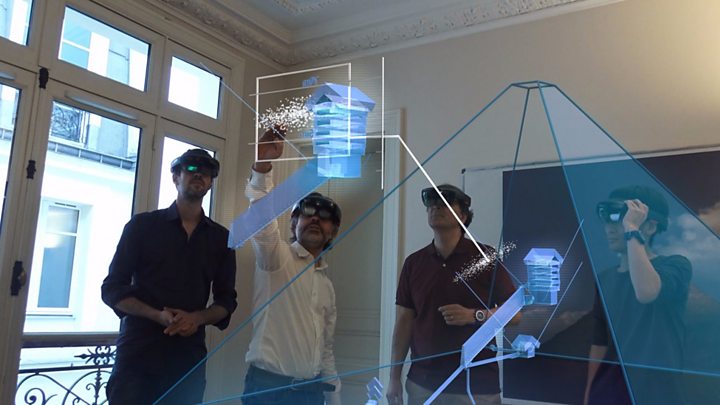
One of the team leaders, Hany Helal from Cairo University, believes the void is too big to have a pressure-relieving purpose, but concedes the experts will debate this.
“What we are doing is trying to understand the internal structure of the pyramids and how this pyramid has been built,” he told reporters.
“Famous Egyptologists, archaeologists and architects – they have some hypotheses. And what we are doing is giving them data. It is they who have to tell us whether this is expected or not.”
Much of the uncertainty comes down to the rather imprecise data gained from muography.
This non-invasive technique has been developed over the past 50 years to probe the interiors of phenomena as diverse as volcanoes and glaciers. It has even been used to investigate the failed nuclear reactors at Fukushima.
Muography makes use of the shower of high-energy particles that rain down on the Earth’s surface from space.
When super-fast cosmic rays collide with air molecules, they produce a range of “daughter” particles, including muons.
These also move close to the speed of light and only weakly interact with matter. So when they reach the surface, they penetrate deeply into rock.
But some of the particles will be absorbed and deflected by the atoms in the rock’s minerals, and if the muon detectors are placed under a region of interest then a picture of density anomalies can be obtained.
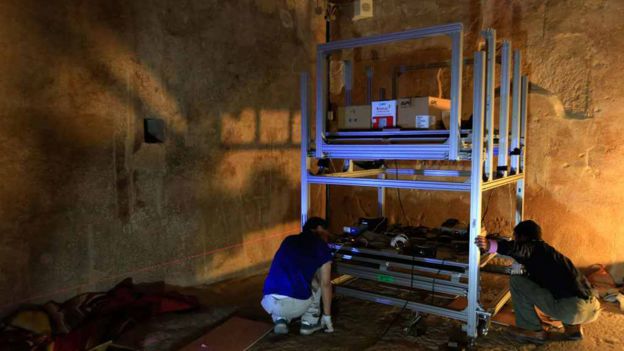
The ScanPyramids team used three different muography technologies and all three agreed on the position and scale of the void.
Sébastien Procureur, from CEA-IRFU, University of Paris-Saclay, emphasised that muography only sees large features, and that the team’s scans were not just picking up a general porosity inside the pyramid.
“With muons you measure an integrated density,” he explained. “So, if there are holes everywhere then the integrated density will be the same, more or less, in all directions, because everything will be averaged. But if you see some excess of muons, it means that you have a bigger void.
“You don’t get that in a Swiss cheese.”
The question now arises as to how the void should be investigated further.
Jean-Baptiste Mouret, from the French national institute for computer science and applied mathematics (Inria), said the team had an idea how to do it, but that the Egyptian authorities would first have to approve it.
“Our concept is to drill a very small hole to potentially explore monuments like this. We aim to have a robot that could fit in a 3cm hole. Basically, we’re working on flying robots,” he said.
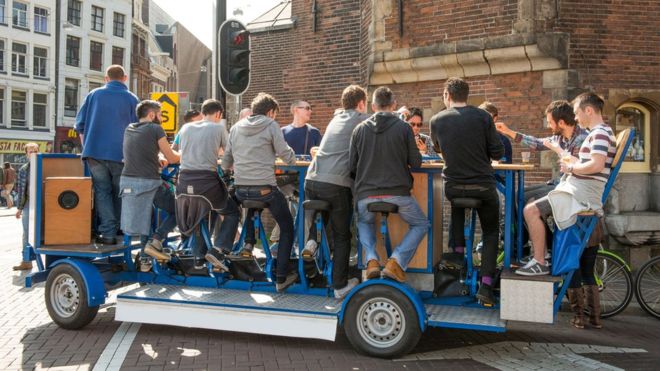
Amsterdam has banned beer bikes amid complaints about rowdy tourists being drunk and disorderly.
A court ruling on Tuesday allowed officials to prohibit their use in the centre of the Dutch city, calling the contraptions a “public order problem”.
The bicycles are a popular way for tourists celebrating group events, such as stag parties, to travel around Amsterdam.
Critics say they have become an example of the problems caused by mass tourism.
The beer bikes are small carts that have been modified with bicycle seats arranged around a bar table.
The ban came into force on Wednesday. A spokesman for the City Hall said operators were no longer allowed to rent out the bikes.
It comes after the Amsterdam District Court said “the beer bicycle may be banned from the city centre to stop it from being a nuisance”.
Last year, about 6,000 locals signed a petition calling on the council to ban the bikes, calling them a “terrible phenomenon”.
At the time, one resident told NOS news: “Our city has become a giant attraction park.”

By Anna Holligan, BBC News
You normally hear them before you see them.
For some tourists these cumbersome contraptions offer the perfect way to see the city. Combining two of its attractions – alcohol and cycling.
The Dutch are famous for their cycling culture but few will miss the inebriated foreigners who commandeer these novelty vehicles, sometimes at the expense of those who use bikes as a practical and sensible way to get on with life.
Amsterdam’s late mayor, Eberhard van der Laan – who died last month – agreed with the residents and instituted a ban on the bikes.
This was challenged in court last year by four beer bike operators, who said that the city was “imposing on people’s freedom”.
Judges struck down the mayor’s ban at the time, saying that it was not properly motivated.
In a ruling on Tuesday, however, the judges at the Amsterdam District Court agreed with the ban.
“The combination of traffic disruptions, anti-social behaviour and the busy city centre justifies a ban,” they said.
Want to have the best chance of experiencing the paranormal? Join us at one of our paranormal events in some of the most haunted and creepy places in the UK!
Although our specialty here at Haunted Rooms is the UK and Ireland’s most haunted places, we’re fascinated by any haunted place, and there are definitely lots of them about. So, we have decided to put together what we think are the most haunted places in the world. See our sister site for the most haunted places in America.
Below you’ll find a list of 21 of the scariest places on earth, some of which you will most likely of heard of, and some of which you may have not. What is for sure though, is that you’ll likely want to read some of these creepy stories with the lights on!
![By Davidt8 (Own work) [Public domain], via Wikimedia Commons](https://www.hauntedrooms.co.uk/wp-content/uploads/2013/09/Eastern_state_penitentiary-500x376.jpg)
Built in 1829, Eastern State Penitentiary is a former prison in Philadelphia, Pennsylvania. It’s known for being the very first prison of its kind to introduce solitary confinement, or what they used to call, the Pennsylvania System. Prisoners were sent to solitary during this time as a form of rehabilitation. They would be completely isolated, living alone, eating alone, and even exercising alone in their own individual yards. Whenever an inmate left his cell, a black hood would be placed over his head to assure he remained in confinement.
Due to Eastern States’ harsh approach, many prisoners were driven to insanity, and as a result, the Pennsylvania System was scrapped in 1913. From then until 1970 it was used as a regular prison and held the likes of Al Capone and the bank robber, Willie Sutton.
Reports of the paranormal have been going on since the 1940’s, but ever since the stone prison was abandoned in 1971, paranormal experiences have seemingly increased.
Reports include:

Waverly Hills was originally a two-story wooden building that was opened in 1910, however, the building you see today was constructed in 1926. It served as a tuberculosis hospital throughout the early to mid 20th Century, a time when the disease was at its worst. It is believed that as many as 63,000 patients died there. The death toll as well as the supposed mistreatment and questionable experimental procedures on patients are all recipes that may be behind one of the most haunted buildings in the whole of the US.
The Waverly Hills Sanatorium has built quite the reputation over the years as more and more people are allowed to investigate the premises. This has thrown up some incredible evidence over the years. It has featured on shows such as Ghost Adventures, Ghost Hunters (TAPS), and our very own Most Haunted. TAPS captured a figure on their thermal imaging camera that seemed to be walking across the hall. The figure was about 3ft tall, they later found out that the ghost of a young boy named Tim has been spotted there before.
There are vast amounts of varying reports, including full bodied apparitions, fleeting shadows, screams from empty rooms, footsteps, sudden cold spots, and disembodied voices among many others.

The historic Monte Cristo Homestead in Junee, New South Wales is regarded as the most haunted location in Australia. Its reputation is believed to stem from a number of tragic events that have occurred there since it was built in 1885. From the time of its construction up to 1948, the Crawley family owned and resided in the property. During this time the family laid witness to many deaths, including the tragic death of a young child who was dropped down the stairs. A maid to the family is believed to have fallen from the balcony, and a stable boy apparently burned to death on the property.
There was also a mentally ill man named Harold (the son of a caretaker) who was chained up in the caretaker’s cottage for 40 years. He was found curled up next to the body of his dead mother and sent to a mental institute where he died shortly after.
The tragedy doesn’t end with the Crawley’s. After the house was left in 1948, it was taken over by a group of caretakers, one of whom was murdered in the caretaker’s cottage.

The Castle of Good Hope in Cape Town, South Africa was built in the 17th century by the Dutch East India Company. It’s the country’s oldest colonial building, originally serving as a replenishment station for ships passing the treacherous waters of the Cape.
The first reported paranormal occurrence was when the apparition of a tall gentleman was seen in 1915 on one of the castles’ ramparts. The man wasn’t seen again until 1947 when he was seen on a regular basis over a two week period. He would be seen jumping off the side of one of the castle walls and walking between the bastions Leerdam and Oranje.
One of the most popular stories associated with the Castle is the former governor Pieter Gysbert van Noodt. He died on 23 April 1728, the same day he had sentenced to death seven soldiers who were caught attempting to desert the military. It’s believed one of the soldiers placed a curse on him and demanded he came to watch the execution, which he didn’t. Later that day, Van Noodt was found dead slouched over his desk with a look of terror on his face.
Another famous haunting is the Lady in Grey. She has been witnessed running through the castle holding her face and crying hysterically. However, since a woman’s body was found during recent excavations her ghost hasn’t been reported.
Sometime in the 1700’s, a soldier was found hanging from the bell rope in the bell tower, which overlooks the entrance to the castle. After his death, the bell tower was sealed off, however, to this day the bell has been known to strike off its own accord. There’s also the ghost of a black dog who has been known to pounce on unsuspecting visitors, then simply vanish into thin air.

With a history of torture and execution going back over 900 years, the Tower of London is regarded by many as one of the most haunted places in the UK. It was originally built in 1078 by William the Conqueror and has served a major role in the history of England ever since.
There have been many reports of the paranormal at the Tower of London over the years. The most famous of all the ghosts that live within its walls, is Anne Boleyn, the wife of King Henry VIII. She was beheaded in 1536, and her headless body has been seen walking the Tower’s corridors and often near the spot of her demise.
Other full bodied apparitions have also been seen including Lady Jane Grey, who was spotted by a guardsman in 1957. In the White Tower, the White Lady has been seen, often standing at the window, where she once stood waving to her children on the other side of the building.
Perhaps the most spine chilling of all reports includes the mysterious appearance of two children. They have been witnessed throughout the rooms of the castle. They’re often seen in their nightgowns, holding hands and with a look of terror on their faces. It is believed these are two former Prince’s, who was sent to the Tower after they were deemed illegitimate by Parliament. They vanished one day and it was assumed that they were murdered by order of their uncle, the Duke of Gloucester. Apparently, two small skeletons were exhumed beneath a staircase in the White Tower.

Built in 1145, the Ancient Ram Inn is believed to be the most haunted house in the entire British Isles, and perhaps the most haunted house in the world. The tales of child sacrifices, devil worship, and evil spirits are believed to be behind the terrifying happenings in this building. The Inn was built on the intersection of 2 ley lines, what many people believe is a conductor for spiritual activity. In addition, an ancient Pagan burial ground is said to have resided in the property over 5,000 years ago.
During its time as a bed and breakfast, people would often flee in the middle of the night, often seeing full bodied apparitions in their rooms, the feeling of being touched/pulled, disembodied voices, and the just the general feeling of evil.
John, the current owner, and resident of the Ram Inn, has reported that on his first night in the house in 1968, he felt a presence grab his arm, before being dragged out of bed and across the room! John has since found evidence of devil worship and ritual sacrifice. He found two child skeletons underneath the staircase, as well as broken daggers. He continues to experience the hauntings and the attacks to this day.

Labelled as Canada’s most haunted historic site, the Halifax Citadel has received hundreds of reports of ghost sightings over the years. Situated at the summit of Citadel Hill in the town of Halifax, Nova Scotia, this star shaped fort is almost 300 years old, with the original foundations being built in 1749, and reconstructed in 1856.
Staff and visitors have reported several apparitions walking the grounds here, with one particular visitor witnessing a soldier in uniform walk into one of the rooms in the old prison area and simply vanish. This is a common theme with many reports centered around apparitions. Other ghostly figures that have been witnessed include an old man, a woman, a man in a red cloak, and an older lady who has been known to show herself in mirrors.
A little girl is said to follow the groups taking part in the ghost tours, with group members often experiencing her holding their hands. Other reports include disembodied voices, unexplained bangs, and knocks, mists captured on film and with the naked eye. The feeling of being watched is a common complaint, as is the sudden feeling of nausea, sudden gusts of wind in closed off rooms, furniture moving, doors banging, and on occasion, people have been pushed by an unseen force.

The Banff Springs hotel in Alberta Canada, was built over 125 years ago by the Canadian Pacific Railway, as a luxury stop off point for train travelers. Don’t let its picturesque surroundings fool you though, it’s rumoured to be one of the most haunted in the country.
Terrifying reports include the sighting of a bride who fell down the staircase breaking her neck after panicking when her dress caught fire. Her apparition has been seen on the staircase and in the ballroom dancing, with many reporting the flames from the back of her dress.
The main story that is told by locals is that of the family that was murdered in room 873. The door to this room has since been bricked up, but the family that lost their lives in this room are still seen to this day, often in the hallway outside the room.
Perhaps the most popular of all the reports is the former bellman, Sam Macauley. He served at the hotel during the 60’s and 70’s, and is still seen to this day. He likes to help guests up to their rooms, dressed in his 60’s uniform, often turning on lights and opening locked doors. If you try and make conversation or tip Sam, he vanishes.

Originally built in the 11th century as a castle by the Counts of Anjou, Château de Brissac was rebuilt in 1502, by Charles II, Duke of Brissac, who gave it its name. This noble castle is the tallest in France, and it exudes old world charm, but one of its past residents has shocked more than one visitor.
A double murder that occurred sometime in the 15th century within the walls of the castle, has resulted in one of the more popular ghosts of the Château de Brissac, that of the la Dame Verte, or “Green Lady”. The current residents (the current Duke of Brissac and his family) have become accustomed to her roaming the rooms, but she has scared many a guest. She is often seen in the tower room of the chapel, wearing her green dress. What’s terrifying, however, is her face. If she looks at you, you’ll see that her face has gaping holes were her eyes and nose should be, resembling what a corpse would look like. As well as her sighting, her moans are also often heard throughout the castle in the early hours.

Borgvattnet is a small village in Jämtland County, Northern Sweden. It’s renowned for having one of the most haunted houses in Sweden, The Old Vicarage, which was built in 1876.
The first ghost ever documented at the vicarage came in 1927 when the chaplain Nils Hedlund resided. He reported many strange happenings including one particular encounter with something paranormal. He was on his way up to the attic to gather his laundry when he witnessed his laundry being torn down from the line by an unseen force.
Rudolf Tangden, a priest who lived at the vicarage during the 1930’s, saw an old woman dressed in grey appear in a room. He followed her as she walked away, but she vanished in front of his eyes. In the 1940’s Tangden’s successor, Otto Lindgren, and his wife said they had several paranormal experiences including unexplained sounds and moving objects.
On one occasion a woman who was staying in the guestroom was awoken in the middle of the night to see 3 old women sitting staring at her. She quickly turned on the light and they were still looking at her, however, they now appeared blurry.
In 1945 the chaplain, Erick Lindgren moved into the vicarage, and he began a journal recounting many of his own experiences in the house. He reported being thrown out of his chair regularly by an unseen force.
The current building is serving as a restaurant/cafe, as well a guest house. If you dare to stay the entire night you’ll receive an overnight-stay-certificate to prove it!
The JFK assassination persists as one of the most widely believed conspiracy theories in history. I believed it was the CIA, Cubans and finally the New Orleans mob that did it. I believed this for years. Then one day my friend told me to read a book on the assassination that came out in the mid nineties titled “Case Closed” by Gerald Posner. My friend said it will change your mind, that Lee Harvey Oswald acted alone, and it did. Every other person I know who read the book has also discarded the conspiracy theory.
Posner’s research into the movements of Oswald is truly astounding, he follows him minute by minute. And Oswald was a very strange, yet highly intelligent character. He was in the U.S. Marines, all Marines learn to be very good shots. But nothing will make the believers change their minds.
As the very good article below by Slate Magazine states, conspiracy theories are very powerful ideas indeed.

There’s no space to launch a full rebuttal of the conspiracy theorists. (It took 1,632 pages for Vincent Bugliosi to do that in his 2007 book Reclaiming History.) But it’s worth recounting the conspiracy buffs’ arguments that I found most persuasive—and why they collapse under scrutiny.
The basic facts are these. On Nov. 22, 1963, President Kennedy, Texas Gov. John Connally, and their wives were riding in a slow, open motorcade through Dallas. At 12:30 p.m., as the car turned onto Dealey Plaza, three gunshots rang out. Kennedy and Connally were both shot. The car sped to a nearby hospital, where the president was pronounced dead and the governor treated for wounds. Lee Harvey Oswald was arrested as the suspected gunman and was himself shot to death days later. President Lyndon Johnson appointed a commission, chaired by Supreme Court Chief Justice Earl Warren, to investigate the assassination. The Warren Report concluded that Oswald had fired all three shots from a window on the sixth floor of the Texas School Book Depository, where he worked.
But the case was far from closed. A man named Abraham Zapruder, one of thousands of people standing along the motorcade route that day in Dallas, captured the shootings on his 8mm home-movie camera. At 26 seconds and 486 frames, it would come to be the most thoroughly examined snuff film in history—and a prime piece of evidence for the Warren Commission and the subsequent “conspiracy buffs.”
At first, it was assumed that Kennedy and Connally had been hit by separate bullets. But the Zapruder film threw a wrench in that notion. The Warren Commission’s analysts concluded that JFK was shot sometime between Frames 210 and 225 (a street billboard blocked Zapruder’s view at the crucial moment), while Connally was hit no later than Frame 240. In other words, the two men were hit no more than 30 frames apart. However, FBI tests revealed that Oswald’s rifle could be fired no faster than once every 2.25 seconds—which, on Zapruder’s camera, translated, to 40 or 41 frames. In short, there wasn’t enough time for Oswald to fire one bullet at Kennedy, then another at Connally.
The inference was inescapable. Either there were at least two gunmen—or Kennedy and Connally were hit by the same bullet. The Warren Report argued the latter. The “single-bullet theory,” as it was called, set off a controversy even among the commissioners. Three of them didn’t buy it. Under political pressure to issue a unanimous report (preferably one reassuring the American public that there was only one gunman and he was dead), the skeptics stifled their dissent, at least publicly; in exchange, the report’s authors toned down their assessment of the single-bullet theory from “compelling” (the first draft’s term) to merely “persuasive.”
That section of the Warren Report drew the most biting attacks. Critics drew diagrams tracing the absurd path that a bullet would have had to travel—a midair turn to the right, followed by a squiggly one to the left—in order to rip through Kennedy’s neck, then into Connally’s ribs and wrist.
For many years, long after I’d rejected most of the conspiracy buffs’ claims, the “magic bullet”—as critics called it—remained the one piece of the Dealey Plaza puzzle that I couldn’t fit into the picture; it was the one dissonant chord that, in certain moods, made me think there might have been two gunmen after all.
Then, in November 2003, on the murder’s 40th anniversary, I watched an ABC News documentary called The Kennedy Assassination: Beyond Conspiracy. In one segment, the producers showed the actual car in which the president and the others had been riding that day. One feature of the car, which I’d never heard or read about before, made my jaw literally drop. The back seat, where JFK rode, was three inches higher than the front seat, where Connally rode. Once that adjustment was made, the line from Oswald’s rifle to Kennedy’s upper back to Connally’s ribcage and wrist appeared absolutely straight. There was no need for a magic bullet.
The Grassy Knoll, Part 1: Frame 313
Kennedy was shot twice: first through the neck (by the bullet that went on to pierce Connally), then in the head. The Zapruder film captured this shot too, in Frame 313. The image was deemed so horrifying that it was excised from public viewings of the film until 1975, when President Gerald Ford (who’d served on the Warren Commission) ordered it released. I remember watching the fully restored film on TV. It really was horrifying. You saw the top of President Kennedy’s head literally blown off. But it was creepy for another reason: the blown-off piece of his head blew backward. In other words, it looked like that fatal bullet was fired not from behind Kennedy, like the first bullet, but from in front of him. Were there two gunmen after all—Oswald in the book depository and someone else perched in the area known as the “grassy knoll”?
I went back to the library and scoured the Warren hearings. There I found neurologists testifying that a nerve ending can explode when hit by a bullet and that the two trajectories—where the bullet came from and which way the nerve fragments fly—are not necessarily related. Experiments from the 1940s, in which bullets were fired into the heads of live goats, revealed this fact. So, the evidence of Frame 313 was at least ambiguous; it said nothing, one way or the other, about the plausibility of a second-gunman theory.
However, in 1975, CBS News, which was doing a documentary on the assassination, hired a tech firm to conduct a high-resolution analysis of the Zapruder film, using instruments that hadn’t existed in the Warren Commission’s day. The firm discovered that, on Frame 312, Kennedy’s head slammed a tiny bit forward, and much more quickly than it jolted backward an instant later on Frame 313. The implication: The bullet hit his head from behind, pushing him forward, then a nerve exploded, which happened to push him backward.
The Grassy Knoll, Part 2: The Acoustical Analysis
In 1976, the House of Representatives formed a special committee to reinvestigate the Kennedy assassination. After many hearings and extensive analysis, the panel concluded that there had been a second shooter after all. This surprise conclusion was based on a newly discovered piece of evidence—an audiotape from a radio transmission from a Dallas policeman who’d been escorting JFK’s motorcade. According to the House report, an acoustical analysis of the tape revealed that four gunshots were fired—and that, given the echo patterns and the officer’s location, one of those shots came from the grassy knoll.
The report stirred such commotion that the National Academy of Sciences conducted its own analysis of the tape—and concluded that the House report was hooey. First, it turned out that some of those four gunshot-like sounds were not gunshots. Second, the motorcycle cop in question was not where the House report claimed, so even if the sounds had been gunshots, a revised echo analysis put them someplace other than the grassy knoll. Third, some of the sounds on the tape occurred a minute after the assassination.
Case closed.
The Appeal of Conspiracies
Conspiracy theories thrive—about every big event in history—for several reasons. First, there’s a natural human instinct to fantasize about the hidden. As my Slate colleague Ron Rosenbaum (who’s plumbed these depths as immersively as anyone) put it in his brilliant collection, The Secret Parts of Fortune, “The search for the hidden hand, the hidden springs, the hidden handshake behind history attracts a certain kind of glory seeker, Ancient Mariner, mad scholar, Wandering Jew.”
Second, there is comfort in this search for unseen mainsprings. If horrible events can be traced to a cabal of evildoers who control the world from behind a vast curtain, that’s, in one sense, less scary than the idea that some horrible things happen at random or as a result of a lone nebbish, a nobody. The existence of a secret cabal means that there’s some sort of order in the world; a catastrophic fluke suggests there’s a vast crevice of chaos, the essence of dread.
As the old adage has it, “Big doors sometimes swing on little hinges.” John F. Kennedy’s murder was a big door—had he lived, the subsequent decades might have looked very different—and Lee Harvey Oswald was a preposterously small hinge. The dissonance is wildly disorienting. It makes for a neater fit, a more intelligible universe, to believe that a consequential figure like John Kennedy was taken down by an equally consequential entity, like the CIA, the Mafia, the Soviets, Castro … take your pick.
Finally (and this is a point that some defenders of the Warren Report ignore), there are conspiracies. There’s a reason so many serious people started to reinvestigate the Kennedy assassination in the mid-1970s: that was when Sen. Frank Church’s committee unveiled a long dark history of CIA conspiracies—coups, killings, and other black-bag jobs—that only extremists had ever before imagined possible. What other extreme theories might turn out to be true?
The killing of JFK emerged as an obvious source of renewed curiosity. Back in 1971, not long before he died, a retired Lyndon B. Johnson told the journalist Leo Janos that the Kennedy administration had been “running a damn Murder Incorporated in the Caribbean.” Nobody knew what he was talking about at the time. A few years later, the Church Committee revealed the details of Operation Mongoose—an intense plot by the Kennedy White House and the CIA to assassinate Fidel Castro. Revelations also emerged of the Mafia’s cooperation in Mongoose, of JFK’s affair with a Mafia moll, and of his brother Robert Kennedy’s crusade against the same Mafia kingpins. Could Dallas have been a revenge shooting, mounted by either Castro or the Mafia? Even if Oswald had been the lone gunman, could he have been a recruit in some larger power’s plot?
New suspicions also arose about the Warren Commission. The CIA, it turned out, had accumulated vast files about Oswald’s time in the Soviet Union (he had briefly defected in the late 1950s before returning to the United States) and his visit to the Cuban consulate in Mexico—but the agency turned over none of this material to the Warren staff.
No wonder that even as sober-minded a soul as Secretary of State John Kerry, who was a college student at the time of the assassination, recently told NBC’s Tom Brokaw, “To this day, I have serious doubts that Lee Harvey Oswald acted alone” or that the Warren Commission “got to the bottom” of his “time and influence from Cuba and Russia.”
Yet history plays strange games. The Warren Commission was a compromised outfit from the get-go—and yet, despite a half-century of scrutiny, the report’s central points hold up well. The only remaining mystery, really, is Oswald’s motives—and yet, here too, no convincing evidence has emerged that links his action to the Mafia, the CIA, the Cubans, or anything of the sort. The most persuasive theory I’ve read—first put forth in a New York Review of Books article by Daniel Schorr (later reprinted in his book Clearing the Air)—is that Oswald killed Kennedy, believing the deed would earn him favor with Castro. But who knows? The mystery at the heart of the matter (why did Oswald do it?) remains unsolved. And that of course makes conspiracy theories all the more satisfying.

The Lincoln Futura is a concept car promoted by Ford’s Lincoln brand, designed by Ford’s lead stylists Bill Schmidt and John Najjar, and hand-built by Ghia in Turin, Italy — at a cost of $250,000 (equivalent to $2,200,000 in 2016).
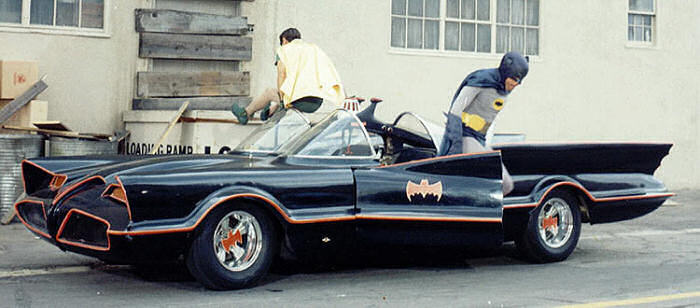
Displayed on the auto show circuit in 1955, the Futura was modified by George Barris into the Batmobile, for the 1966 TV series Batman.
The Futura’s styling was original by 1950s standards — with a double, clear-plastic canopy top, exaggerated hooded headlight pods, and very large, outward-canted tailfins. Nevertheless, the Futura had a complete powertrain and was fully operable, in contrast to many show cars. Its original color was white, and was one of the first pearlescent color treatments, using ground pearl to achieve the paint effect. The Futura was powered by a 368 cubic inch Lincoln engine and powertrain; the chassis derived from a Continental Mark II.
The Futura was a success as a show car, garnering favorable publicity for Ford. It was released as a model kit and a toy, and in a much more subdued form its headlight and tailfin motifs would appear on production Lincolns for 1956 and 1957, such as the Lincoln Premiere and Lincoln Capri. The concave front grille inspired the grille on the 1960 Mercury Monterey and the 1961 Ford Galaxie.


The Futura played a prominent part in the 1959 movie It Started with a Kiss, starring Debbie Reynolds and Glenn Ford. For the movie, it was painted red, as the white pearlescent finish did not photograph well.
The concept car was subsequently sold to auto customizer George Barris. Having originally cost $250,000, the Futura was sold to Barris for $1.00 and “other valuable consideration” by Ford Motor Company. As the car was never titled and was therefore uninsurable, it was parked behind Barris’ shop, sitting idle and deteriorating for several years.


In 1966 Barris was asked to design a theme car for the Batman television series. Originally the auto stylist Dean Jeffries was contracted to build the car for the show in late 1965, but when the studio wanted the car faster than he could deliver, the project was given to Barris. With the short notice, Barris thought the Futura might work well, and using Jeffries’s initial car, decided that its unusual winged shape would be an ideal starting point for the Batmobile. Barris hired Bill Cushenberry to modify the car’s metalwork. Barris went on to build three fiberglass replicas using the frames and running gear from 1966 Ford Galaxie cars for the show circuit, three of which were covered with a felt-like flocking finish in the 1970s. Barris later acquired a fourth replica, a metal car built on a 1958 Thunderbird.
Barris retained ownership of the car, both after its conversion to the Batmobile, leasing it to the TV studio for filming and after production of the TV series ended, displayed in Barris’ own museum in California. It has also been displayed in the Cayman Motor Museum on Grand Cayman Island.
Barris sold the Batmobile to Rick Champagne at the Barrett-Jackson collector car auction on Saturday, January 19, 2013 in Scottsdale, Arizona for US4.62 million dollars.
DALLAS—A controversial new book about the assassination of President John F. Kennedy has raised questions not about the role of a lone gunman or a conspiracy of shooters, but about whether the late president was even even shot at all.
While the book, Outside the Crosshairs, does not dispute the fact that a massive portion of Kennedy’s skull was separated from his head during the 1963 Dallas visit, it maintains that the president suffered fatal explosive- cranial trauma through means completely unrelated to gunshots.
“Certainly extreme force was involved in this tragic death,” said Dr. Horace Musashi, the book’s author and a professor of computer science at Mount Union College in Alliance, OH. “However, none of the available photographs or recorded footage provides even a shred of evidence that an actual bullet did anything to Kennedy’s body. As scientists, therefore, we must consider all other possibilities, no matter how much they challenge the status quo.”
Musashi himself favors an explanation known as the single-massive-spike-in-blood-pressure theory.

After 11 years of painstaking research, Musashi uncovered testimony from anonymous eyewitnesses who claimed that unopened packets of duck sauce and soy sauce were hastily removed from Air Force One after the assassination. According to the book’s findings, the extremely high levels of monosodium glutamate combined with the stress of mediating an intense international ballistic-missile crisis caused Kennedy’s systolic pressure to mount to the point where the right rear quarter of his cranium “shot clean off.”
“Case closed,” Musashi said. “Mass hysteria accounts for everything else.”
The book has also sparked popular interest in a number of related theories. Retired police officer Joseph Czyz, who in 1991 was on the scene at Dealy Plaza for JFK-Fest, an assassination-reenactment weekend, claims Musashi and adherents to the single-massive-spike-in-blood-pressure theory have been led astray by carefully placed red herrings.
Theonion.com

The CNN slogan has been around for eternity it seems. The voice in the promotion is that of actor James Earl Jones. Jones did the voice of Darth Vader in the early Star Wars movies. Darth was not to be trusted, he was a practitioner of the ‘Black Force’. A very evil thing. Jones has a great voice, but using an actor that is synonymous with Darth Vader is no longer such a good idea maybe.
CNN has been under attack from the right and conservatives for years now. They claim CNN preaches ‘Fake News’. They say the news network doesn’t do proper research and relies on too many anonymous sources, leakers. All news organizations rely on anonymous sources. These sources are vetted diligently by the reporters who communicate with them. If they lack credibility they are dropped.
During the Washington Post Watergate investigation ‘Deep Throat’, the source that provided some of the most integral information to the Post reporters Woodward and Bernstein, remained anonymous for decades. This anonymous source helped bring down Richard Nixon!
And then ignorant Star Wars fans who believe that it really is Darth Vader voicing the promo may get the wrong idea. How could a news network have real news when the evil master of the Empire is in cahoots with them?

I watch CNN, and I believe they do their due diligence when it comes to investigating stories. They do have many excellent journalists. In my humble opinion they do hound Trump with a little too much zeal from time to time. But Trump is like shooting fish in a barrel, he is so full of crap and so impetuous that he begs for criticism.
Trump loves Fox news, Fox news comes across as being run by Joseph Goebbels, the Nazi propaganda chief. They are so slanted and biased that it’s amazing how they continue to get millions of dotards to watch them. Fox is a conservative right Republican party advocate with no guilt. They pump out bullshit 24/7, any common sense is out the window. They lie about as much as Trump, well maybe not quite. Fox News is the real ‘FAKE NEWS’!
Antoine Dominique “Fats” Domino Jr. (February 26, 1928 – October 24, 2017) was an American pianist and singer-songwriter of Louisiana Creole descent. He had 35 records in the U.S. Billboard Top 40, and five of his pre-1955 records sold more than a million copies, being certified gold.
From 1955-60, he had eleven top 10 hits and his record sales were reportedly surpassed only by Elvis Presley. During his career, Domino sold over 65 million records. His musical style was based on traditional rhythm and blues, accompanied by saxophones, bass, piano, electric guitar, and drums.

Antoine Dominique Domino Jr. was born and raised in New Orleans, Louisiana, the eighth and final child of Antoine Caliste Domino (1879–1964) and Marie-Donatille Gros (1886–1971). The Domino family was of French Creole background. Louisiana Creole was his first language.
Antoine was born at home with the assistance of his grandmother, a midwife. His name was initially given as Anthony on his birth certificate but was later corrected. His family had newly arrived in the Lower Ninth Ward from Vacherie, Louisiana. His father was a violin player.
He attended the Louis B. Macarty School for less than four grades, leaving to start work as a helper to an ice delivery man. Domino learned to play the piano from his brother-in-law, the jazz guitarist Harrison Verrett, while studying shipping management at his local community college.
The artist was married to Rosemary Domino from 1947 until her death in 2008 and was the father of eight children. Even after his success he continued to live in his old neighborhood, the lower Ninth Ward, until after Hurricane Katrina, when he moved to a suburb of New Orleans.
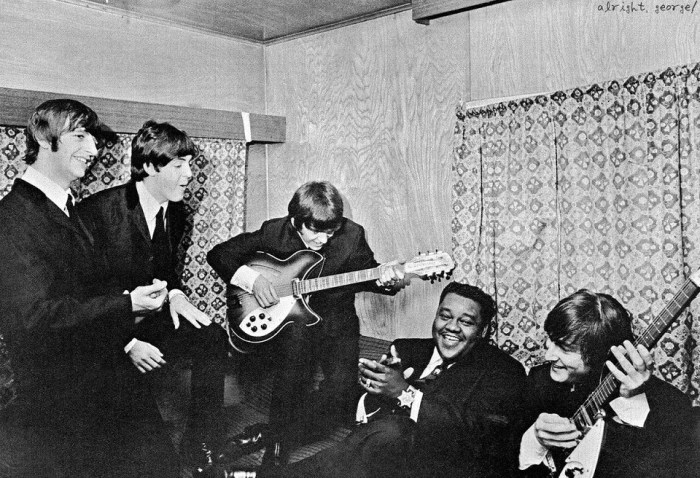
My favourite Fats song
 The MarkoZen Blog