“Linus and Lucy,” Los Straightjackets version of “Peanuts” theme song

Dangerous Minds

straitjackets111315

The luchador-masked garage/surf band Los Straitjackets have been a popular live act for over 20 years, thanks to tight musicianship and energetic, theatrical stage shows. They’re known for sharing stages with other showy, dynamic performers like the burleque troupe The Pontani Sisters, but lately they’ve begun working with someone altogether different—Nick Lowe, the great songwriter and producer who lived the transition from pub rock to New Wave and beyond. Los Straitjackets were a feature of Lowe’s Quality Holiday Revue tour last year, and will be again this year. 

That album will contain Los Straitjackets’ version of the immortal Vince Guaraldi number “Linus and Lucky,” famous as the theme music from the PeanutsTV specials, starting with A Charlie Brown Christmas 50 years ago. Thanks to the Peanuts connection, that song is by far pianist Guaraldi’s best-known work, and there are abundant covers out there, by artists as varied as yuppie jazz institution Wynton Marsalis and indefatigable skate-punks JFA. But if it’s all you know of him, do yourself a favor and pick up Jazz Impressions of Black Orpheus or even just a best-of. He was pretty amazing.

Los Straitjackets are hardly strangers to holiday music—in the late ‘90s, a Straitjackets Christmas appearance on Late Night with Conan O’Brien was an annual tradition, and in 2002 they released ‘Tis the Season for Los Straitjackets. Guitarist Gregorio El Grande discussed the appeal “Linus and Lucy” held for the band to DM in an email exchange:

We listen to all different kinds of instrumental music and always loved the Vince Guaraldi score for A Charlie Brown Christmas. One of the discoveries working on “Linus and Lucy” was finding out the opening riff sounds exactly like the opening riff in “You Really Got Me by The Kinks” when you rock it up. You would never think of those two songs being similar! The best thing about covering this song is seeing everybody doing the Peanuts dances when we play it.

Major Gunboat Diplomacy

A show of force aimed directly at that lunatic dictator in North Korea.

Three U.S. Navy carrier strike groups are operated alongside one another in the Western Pacific through November 14th, 2017. The USS Ronald Reagan (CVN-76), USS Nimitz (CVN-68), and the USS Theodore Roosevelt (CVN-71), along with the Japanese helicopter carrier Ise and its destroyer escorts, are training to work cooperatively as a single punishing force.

carry1

carry

carry2

carry3

carry4

carry5

The “Gates of Hell”

door

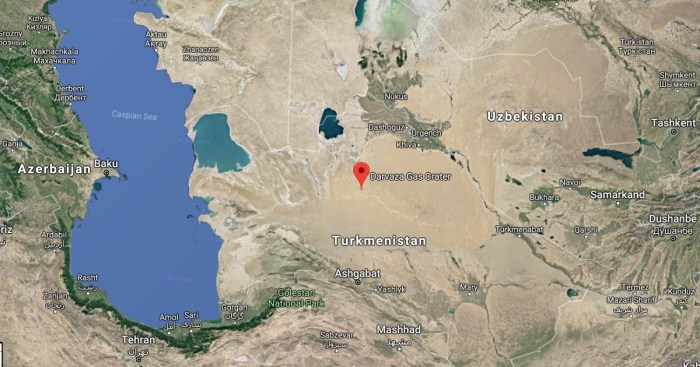
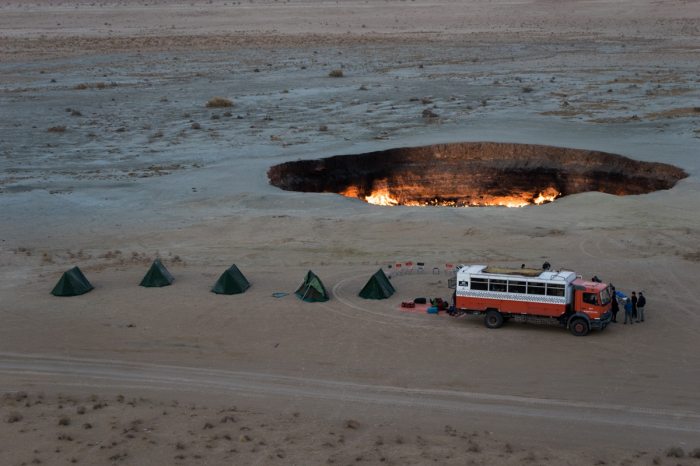
The Darvaza gas crater (Turkmen: Jähennem derwezesi, Җәхеннем дервезеси), known locally as the “Door to Hell” or ”Gates of Hell”, is a natural gas field in Derweze, Turkmenistan, that collapsed into an underground cavern, becoming a natural gas crater. Geologists set it on fire to prevent the spread of methane gas, and it has been burning continuously since 1971. The diameter of the crater is 69 metres (226 ft), and its depth is 30 metres (98 ft).
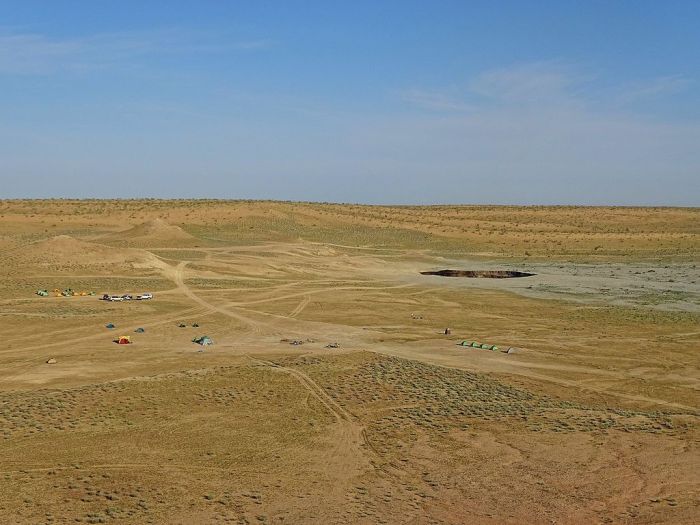
The crater is a popular tourist attraction. Since 2009, 50,000 tourists have visited the site. The gas crater has a total area of 5,350 m2. The surrounding area is also popular for wild desert camping.

The gas crater is located near the village of Derweze, also known as Darzava. It is in the middle of the Karakum Desert, about 260 kilometres (160 mi) north of Ashgabat, the capital of Turkmenistan. The gas reserve found here is one of the largest in the world. The name “Door to Hell” was given to the field by the locals, referring to the fire, boiling mud, and orange flames in the large crater, which has a diameter of 70 metres (230 ft). The hot spots range over an area with a width of 60 metres (200 ft) and to a depth of about 20 metres (66 ft).

door3

According to Turkmen geologist Anatoly Bushmakin, the site was identified by Soviet engineers in 1971. It was originally thought to be a substantial oil field site. The engineers set up a drilling rig and operations to assess the quantity of oil available at the site. Soon after the preliminary survey found a natural gas pocket, the ground beneath the drilling rig and camp collapsed into a wide crater and was buried.
Expecting dangerous releases of poisonous gases from the cavern into nearby towns, the engineers thought it best to burn the gas off. It was estimated that the gas would burn out within a few weeks, but it has instead continued to burn for more than four decades.

door2

In April 2010, the president of Turkmenistan, Gurbanguly Berdimuhamedow, visited the site and ordered that the hole should be closed. In 2013, he declared the part of the Karakum Desert with the crater a nature reserve.

The crater was featured in a Die Trying episode titled “Crater of Fire”. Explorer George Kourounis became the first person to ever set foot at the bottom, gathering samples of extremophile microorganisms. The episode was broadcast on the National Geographic Channel on July 16, 2014.

door1

Camping on the edge of the “Gates of Hell”

door4

Winnipeg Jets play by play guy sounds like Marvin the Martian

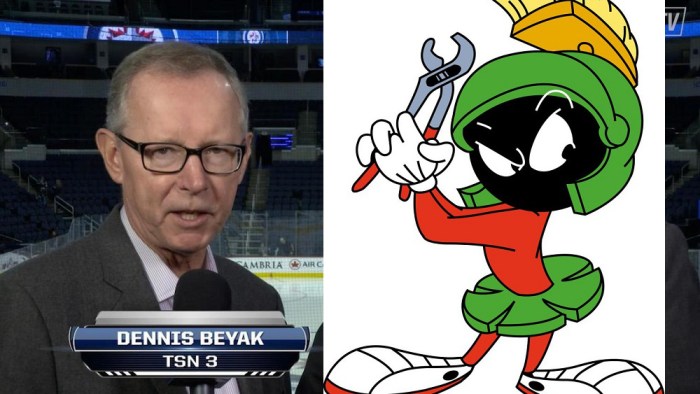
Dennis Beyak is a wily old hockey broadcaster who does the play by play for the Jets. He has been around since before the invention of the jet engine. The old dog is likely on his last few laps around the NHL.

One thing about the guy is that he sounds like ‘Marvin the Martian’ from Merry Melodies cartoons fame. Beyak does not have a deep man’s man voice, but rather a high pitched squawk. Check it out.

marvinxxxx1

Rockin Batman theme by Link Wray and his Raymen

Fred Lincoln “Link” Wray Jr (May 2, 1929 – November 5, 2005) was an American rock and roll guitarist, songwriter and vocalist who first came to popularity in the late 1950s.

Building on the overdriven, distorted electric guitar sound of early electric blues records, his 1958 instrumental hit “Rumble” by Link Wray and his Ray Men invented “the power chord, the major modus operandi of modern rock guitarists”,making possible “punk and heavy rock”. Rolling Stone placed Wray at number 45 of the 100 greatest guitarists of all time. In 2013 he was announced as a nominee for the Rock and Roll Hall of Fame.


LinkWray2


Joe Satriani: master of the guitar strings

Joseph “Joe” Satriani (born July 15, 1956) is an American instrumental rock guitarist and multi-instrumentalist. Early in his career, Satriani worked as a guitar instructor, with many of his former students achieving fame, such as Steve Vai, Larry LaLonde, Rick Hunolt, Kirk Hammett, Andy Timmons, Charlie Hunter, Kevin Cadogan, and Alex Skolnick; he then went on to have a successful solo music career. He is a 15-time Grammy Award nominee and has sold over 10 million albums, making him the biggest-selling instrumental rock guitarist of all time.

In 1988, Satriani was recruited by Mick Jagger as lead guitarist for his first solo tour. In 1994, Satriani toured with Deep Purple as the lead guitarist. He has worked with a range of guitarists during the G3 tour, which he founded in 1995. His G3 collaborators have included Vai, LaLonde, Timmons, Steve Lukather, John Petrucci, Eric Johnson, Yngwie Malmsteen, Brian May, Patrick Rondat, Paul Gilbert, Adrian Legg, Kenny Wayne Shepherd, Steve Morse and Robert Fripp. Satriani has been the lead guitarist for the supergroup Chickenfoot since co-founding the band in 2008. Since 1988, he has been using his own signature guitars, the Ibanez JS Series, which are sold in music stores worldwide. He has also collaborated with Vox to create his own wah, delay, overdrive and distortion pedals as well as a collaboration with Marshall Amplification for the creation of his own signature series amplifier head, the JVM410HJS.


joe

Satriani is considered to be a highly technical guitarist, and has been referred to as a top guitar virtuoso. Satriani has mastered many performance techniques on electric guitar, including legato, two-handed tapping and arpeggio tapping, volume swells, harmonics and extreme whammy bar effects. During fast passages, Satriani favors a legato technique (achieved primarily through hammer-ons and pull-offs) that yields smooth and flowing runs. He is also adept at other speed-related techniques such as rapid alternate picking and sweep picking. Satriani was influenced by blues-rock guitar icons such as Jimi Hendrix, Brian May, Eric Clapton, Jimmy Page, Ritchie Blackmore and Jeff Beck, as well as jazz fusion guitarist Allan Holdsworth.