I have never seen the Assiniboine this low. Not sure why this is.
♠
♣
♥
Osborne usually never goes below 5 feet. This is amazing.
♦
◊
 Image copyrightFULARIOUSTV/YOUTUBE
Squint and it could be a real car ad.
With sweeping aerial shots and professional-looking production, Max Lanman’s advert for a Honda Accord wouldn’t look out of place on TV.
But the Accord in question is a used 1996 model owned by Mr Lanman’s girlfriend, with 141,095 miles on the clock and a $499 (£380) price tag.
When she wanted to sell, filmmaker Mr Lanman applied his talents to produce a spoof ad, and it may have paid off – bids on Ebay currently top $100,000.
Whether that transpires to be a real bid remains to be seen, but the ad has gone viral and the old car, nicknamed Greenie, looks set to go for far more than the price advertised in the short film.
The ad, with a cinematic voice-over which parodies the real deal, features an actress driving the car in LA.
There are close-ups of a vintage-looking tape-deck, as well as rubber duckies and a coffee pot strapped into the passenger seat.
“You, you’re different,” the narrator says, as the ad begins. “You do things your way. That’s what makes you one of a kind.”
The one-minute spot culminates with its own spoof tongue in cheek tagline: “Luxury is a state of mind”.
 Image copyrightFULARIOUSTV/YOUTUBE
 Image copyrightFULARIOUSTV/YOUTUBE
“The inspiration to make the ad came while my girlfriend Carrie and I were driving up the coast on Highway 1, heading to Big Sur to go camping,” Mr Lanman told the BBC.
“It dawned on me that it would be really funny to film a car commercial for a really crappy car against such a gorgeous backdrop.”
It was an “absolutely insane” experience watching the spoof ad go viral, Mr Lanman said.
“It is surreal to think that something that I made with my friends, that two days ago sat on my computer, is now being watched around the world. Thank God for the internet.”
 Image copyrightMAX LANMAN
The BD-5 Micro is a series of small, single-seat homebuilt aircraft created in the late 1960s by US aircraft designer Jim Bede and introduced to the market primarily in “kit” form by the now-defunct Bede Aircraft Corporation in the early 1970s.
In total, only a few hundred BD-5 kits were completed, although many of these are still being flown today. The BD-5J version holds the record for the world’s lightest jet aircraft, weighing only 358.8 lb (162.7 kg).


With the demise of the Bede Aircraft Company, the BD-5 entered a sort of limbo while builders completed their kits. The early safety problems and the challenge of adapting a suitable engine exacerbated delays. Over the next few years, however, solutions to most of these problems arrived in one form or another. Many other changes have also been incorporated to improve the original design. Today the BD-5 is a rewarding, if demanding aircraft.



General Characteristics
Performance

The pretty seaside town and resort of Nazaré on the west coast of Portugal remains crowded throughout the summer with tourists who flock to its long sandy beaches to relax, swim and surf. But when winter arrives, only the most serious thrill seekers stay. At this time, the beaches are dangerous. Massive waves up to 100 feet high regularly break along the rocky coastline.
Nazare’s monster waves attract big wave surfers from all around, but until very recently, the town and its surfing potential was relatively unknown outside Europe. Nazare hit headlines only in November 2011 when Hawaiian surfer Garrett McNamara surfed a record breaking giant wave measuring 78 feet from trough to crest. In January 2013, McNamara returned to Nazare and broke his own record by successfully riding a wave that was estimated to be 100 feet tall. Later in October the same year, Brazilian big-wave hero Carlos Burle rode a wave that appeared to be even bigger. Nazaré on the Atlantic coast has now become a legendary spot in the world of big wave surfing.

How does Nazaré manage to generate waves of colossal size with such regularity? The answer lies in Nazare’s rare undersea geography. Just off the coast of Nazare is the biggest underwater ravine in Europe called Nazaré Canyon. This huge canyon runs 125 miles from the abyssal plain of the Atlantic Ocean to less than half a mile from the coastline, pointing towards the town like an arrow. At its deepest point, the canyon floor is more than 3 miles beneath the surface and it rises rapidly to a canyon “headwall” that rises to between 100 and 150 feet just off the coast of Praia do Norte beach, which is where some of the biggest waves has been known to occur.
The swells originate in the North Atlantic from giant storms in wintertime, and as they arrive near Nazare their energy gets focused and amplified by the narrow canyon just like a magnifying glass focuses the suns energy into a small region. From the headwall to the coastline, the seabed rises abruptly that enables the waves to climb really big all of a sudden. Just before it reaches the coastline, the sea becomes shallow enough for the now amplified swells to break in gigantic waves.
All other big wave spots around the globe — Teahupoo in Tahiti, the Banzai Pipeline in Hawaii, and Mavericks off northern California — have similar undersea geography.


Surfer Sebastian Steudtner from Germany rides a big wave, while above a crowd watches from the cliffs at Praia do Norte in Nazaré.


A surfer drops in on a large wave at Praia do Norte, in Nazare December 11, 2014. Praia do Norte beach has gained popularity with big wave surfers since Hawaiian surfer Garrett McNamara broke a world record for the largest wave surfed here in 2011.


Ozzie does a great job
1969
The Chemosphere is a strange looking house located in the San Fernando Valley area of Los Angeles. It was built in 1960 by by American architect John Lautner. It is a one story octagon with around 2200 square feet (200m2) of living space. Most distinctively, the house is perched atop a concrete pole nearly thirty feet high. This innovative design was Lautner’s solution to a site that, with a slope of 45 degrees, was thought to be practically unbuildable. Access is by a long stairway and a cable railway.
Because of a concrete pedestal, almost 20 feet (6.1 m) in diameter, buried under the earth and supporting the post, the house has survived earthquakes and heavy rains.
The building was first used in a dramatic film as a futuristic residence in the 1964 ABC-TV program “The Outer Limits: The Duplicate Man,” based on a science fiction story by American author Clifford D. Simak. Exterior scenes for the television episode were shot on location; a detailed sound-stage set of the house’s interior was built.


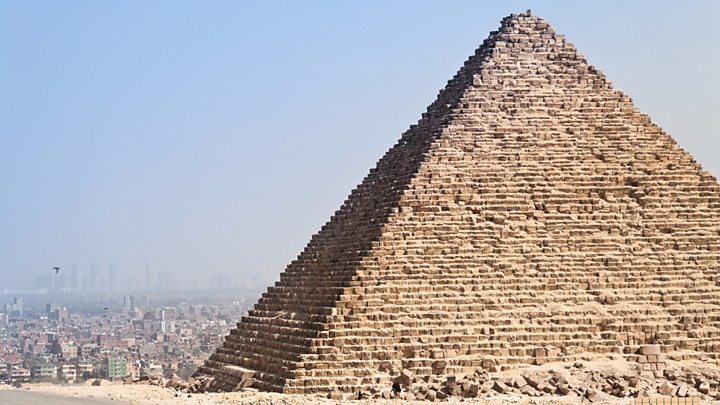
The mysteries of the pyramids have deepened with the discovery of what appears to be a giant void within the Khufu, or Cheops, monument in Egypt.
It is not known why the cavity exists or indeed if it holds anything of value because it is not obviously accessible.
Japanese and French scientists made the announcement after two years of study at the famous pyramid complex.
They have been using a technique called muography, which can sense density changes inside large rock structures.
The Great Pyramid, or Khufu’s Pyramid, was constructed during the reign of Pharaoh Khufu between 2509 and 2483 BC.
At 140m (460 feet) in height, it is the largest of the Egyptian pyramids located at Giza on the outskirts of Cairo.
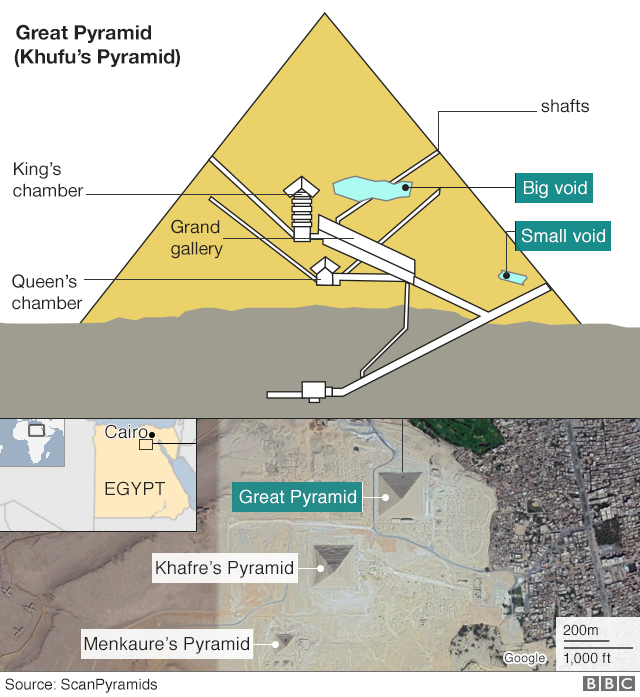

Khufu famously contains three large interior chambers and a series of passageways, the most striking of which is the 47m-long, 8m-high Grand Gallery.
The newly identified feature is said to sit directly above this and have similar dimensions.
“We don’t know whether this big void is horizontal or inclined; we don’t know if this void is made by one structure or several successive structures,” explained Mehdi Tayoubi from the HIP Institute, Paris.
“What we are sure about is that this big void is there; that it is impressive; and that it was not expected as far as I know by any sort of theory.”
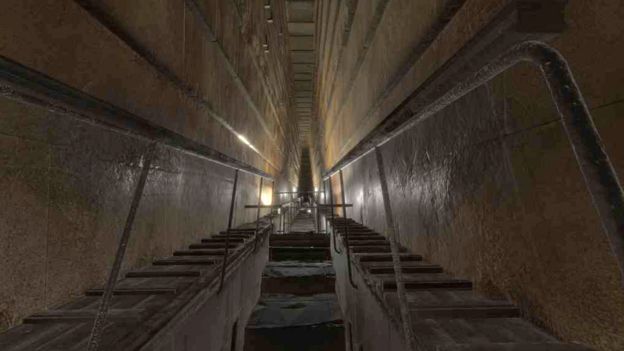 Image copyrightSCANPYRAMIDS
The Scan pyramids team is being very careful not to describe the cavity as a “chamber”.
Khufu contains compartments that experts believe may have been incorporated by the builders to avoid collapse by relieving some of the stress of the overlying weight of stone.
The higher King’s Chamber, for example, has five such spaces above it.
The renowned American archaeologist Mark Lehner sits on a panel reviewing ScanPyramids’ work.
He says the muon science is sound but he is not yet convinced the discovery has significance.
“It could be a kind of space that the builders left to protect the very narrow roof of the grand gallery from the weight of the pyramid,” he told the BBC”s Science in Action programme.
“Right now it’s just a big difference; it’s an anomaly. But we need more of a focus on it especially in a day and age when we can no longer go blasting our way through the pyramid with gunpowder as [British] Egyptologist Howard Vyse did in the early 1800s.”

One of the team leaders, Hany Helal from Cairo University, believes the void is too big to have a pressure-relieving purpose, but concedes the experts will debate this.
“What we are doing is trying to understand the internal structure of the pyramids and how this pyramid has been built,” he told reporters.
“Famous Egyptologists, archaeologists and architects – they have some hypotheses. And what we are doing is giving them data. It is they who have to tell us whether this is expected or not.”
Much of the uncertainty comes down to the rather imprecise data gained from muography.
This non-invasive technique has been developed over the past 50 years to probe the interiors of phenomena as diverse as volcanoes and glaciers. It has even been used to investigate the failed nuclear reactors at Fukushima.
Muography makes use of the shower of high-energy particles that rain down on the Earth’s surface from space.
When super-fast cosmic rays collide with air molecules, they produce a range of “daughter” particles, including muons.
These also move close to the speed of light and only weakly interact with matter. So when they reach the surface, they penetrate deeply into rock.
But some of the particles will be absorbed and deflected by the atoms in the rock’s minerals, and if the muon detectors are placed under a region of interest then a picture of density anomalies can be obtained.
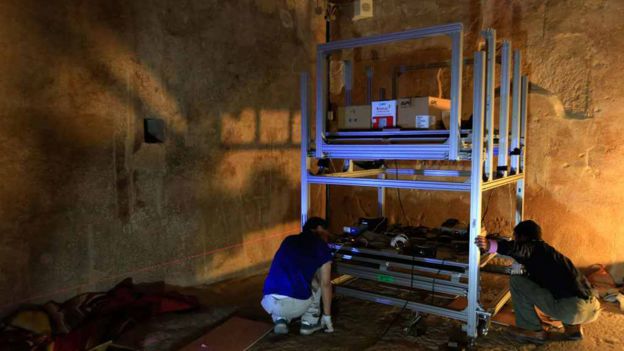
The ScanPyramids team used three different muography technologies and all three agreed on the position and scale of the void.
Sébastien Procureur, from CEA-IRFU, University of Paris-Saclay, emphasised that muography only sees large features, and that the team’s scans were not just picking up a general porosity inside the pyramid.
“With muons you measure an integrated density,” he explained. “So, if there are holes everywhere then the integrated density will be the same, more or less, in all directions, because everything will be averaged. But if you see some excess of muons, it means that you have a bigger void.
“You don’t get that in a Swiss cheese.”
The question now arises as to how the void should be investigated further.
Jean-Baptiste Mouret, from the French national institute for computer science and applied mathematics (Inria), said the team had an idea how to do it, but that the Egyptian authorities would first have to approve it.
“Our concept is to drill a very small hole to potentially explore monuments like this. We aim to have a robot that could fit in a 3cm hole. Basically, we’re working on flying robots,” he said.

Amsterdam has banned beer bikes amid complaints about rowdy tourists being drunk and disorderly.
A court ruling on Tuesday allowed officials to prohibit their use in the centre of the Dutch city, calling the contraptions a “public order problem”.
The bicycles are a popular way for tourists celebrating group events, such as stag parties, to travel around Amsterdam.
Critics say they have become an example of the problems caused by mass tourism.
The beer bikes are small carts that have been modified with bicycle seats arranged around a bar table.
The ban came into force on Wednesday. A spokesman for the City Hall said operators were no longer allowed to rent out the bikes.
It comes after the Amsterdam District Court said “the beer bicycle may be banned from the city centre to stop it from being a nuisance”.
Last year, about 6,000 locals signed a petition calling on the council to ban the bikes, calling them a “terrible phenomenon”.
At the time, one resident told NOS news: “Our city has become a giant attraction park.”

By Anna Holligan, BBC News
You normally hear them before you see them.
For some tourists these cumbersome contraptions offer the perfect way to see the city. Combining two of its attractions – alcohol and cycling.
The Dutch are famous for their cycling culture but few will miss the inebriated foreigners who commandeer these novelty vehicles, sometimes at the expense of those who use bikes as a practical and sensible way to get on with life.
Amsterdam’s late mayor, Eberhard van der Laan – who died last month – agreed with the residents and instituted a ban on the bikes.
This was challenged in court last year by four beer bike operators, who said that the city was “imposing on people’s freedom”.
Judges struck down the mayor’s ban at the time, saying that it was not properly motivated.
In a ruling on Tuesday, however, the judges at the Amsterdam District Court agreed with the ban.
“The combination of traffic disruptions, anti-social behaviour and the busy city centre justifies a ban,” they said.

 The MarkoZen Blog