The Time Tunnel

There was a science fiction TV show from the 1960’s called the Time Tunnel in which a massive U.S. government agency was building a time machine, called the Time Tunnel.  The show itself was basically the adventures of two scientists who go back in time to prominent historic events and occasionally forward into the future. 

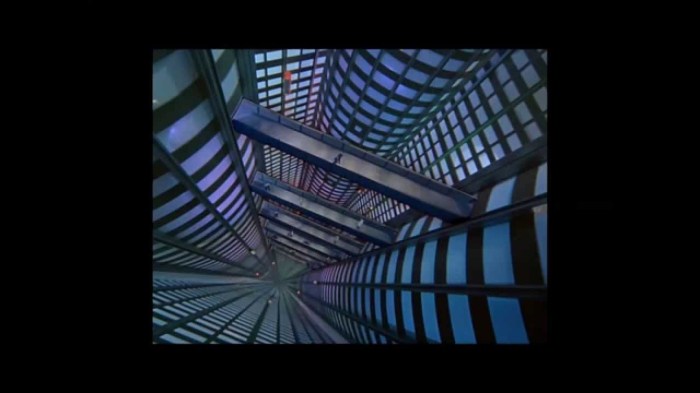
But the best part of the show was the underground base in which the Time Tunnel was located.  36,000 people worked in the giant underground base in Arizona.  Entering the base was done by going through a Batcave like entrance and then driving into a colossal parkade.  The ground above the base looked like regular desert.  The corridors and walkways in the base crisscrossed over thousand foot high drops. 

This must be one of the best underground bases ever conceived.

00tunnel

Project Tic-Toc is a top secret U.S. government effort to build an experimental time machine, known as “The Time Tunnel” due to its appearance as a cylindrical hallway. The base for Project Tic-Toc is a huge, hidden underground complex in Arizona, 800 floors deep and employing over 36,000 people. The directors of the project are Dr. Douglas Phillips (Robert Colbert), Dr. Anthony Newman (James Darren), and Lt. General Heywood Kirk (Whit Bissell). The specialists assisting them are Dr. Raymond Swain (John Zaremba), a foremost expert in electronics, and Dr. Ann MacGregor (Lee Meriwether), an electro-biologist supervising the unit that determines how much force and heat a time traveler is able to withstand. The series is set in 1968, two years into the future of the actual broadcast season, 1966-67.

Backstreet Boys Go Religious

From teeny bopper tunes to God, Cowboys and Mamma, this crazy world never ceases to amaze.

This is selling out in the extreme. Anything for the almighty buck.

On August 19, 2016, the group released “God, Your Mama, and Me”, with country duo Florida Georgia Line, which was taken from their third studio album Dig Your Roots. The song entered the Hot 100 at No. 92 for the chart dated March 18, 2017, which was the group’s first return to the chart since 2007.

World’s Largest Miniature Airport in Hamburg, Germany


airport


airport1

The world’s largest model airport has opened at Miniatur Wunderland in Hamburg, Germany, which is also home to the world’s largest model railway landscape.

The model airport is based off of Hamburg’s Fuhlsbüttel International airport.


airport2

In the past years, embedded between Knuffingen and Switzerland, Miniatur Wunderland’s latest layout arose – our passenger airport. After more than 6 years of construction, it was inaugurated on May 4th 2011, at last. The development of the Airport began in June 2005, already. In 2008 the planning phase was finalized, and the final building plans were worked out.
Since the 22nd of August 2008 the plan was lying on the layout base, initiating the construction phase, officially. The layout arose right in front of our visitor’s eyes. Not only for aviation and technology fans, the impressive Airport is the new Wunderland highlight. Up to 40 different aircraft (from Cessna to Airbus A 380) are taxiing independently on this Airport to the gates. They are also being moved back from the gates by push-back vehicles in order to taxi to the runway. There they are accelerating and taking off or landing respectively. Each aircraft is equipped with original lights and original, realistic turbine sounds at least in the take-off phase (otherwise the noise level would be unbearable).


airport3


airport4


airport5


airport6


airport7


airport8


airport9


airport10


airport11


The Lakes of Afghanistan

The name Afghanistan invokes images of a dry and arid country with mountainous terrain, endless desert, thorn bushes and mud houses. But at the center of this depressing landscape is a series of spectacular lakes with water so blue that it looks almost like ink.

Band-e Amir is a series of six incredibly deep blue lakes in the heart of the central Afghanistan. The lakes are situated in the foothills of the Hindu Kush, the second highest mountain range in the world, 80 kilometers from the ancient town of Bamiyan, where the Taliban destroyed the world’s tallest Buddha statues in 2001. Surrounded by pink towering limestone cliffs almost in complete lack of vegetation, the stunning lakes seems totally out of place.

The beautiful lakes were created by the carbon dioxide rich water that is drawn from the spring melt-water in the surrounding mountains and came out from faults and cracks in the rocky landscape. This outflow of water percolates slowly through the underlying limestone, dissolving its principal mineral, calcium carbonate. Over time, the water deposited layers of hardened mineral (travertine), which created dams that trap water in increasingly large basins. These dams are usually about 10m high and 3m wide. Water cascades from one lake to the other near travertine terraces serving as massive natural dams between the lakes.


The deep blue color of the lakes is due to the clarity of the air as well as the purity of the water. The high mineral content of the lakes also causes the intense and varying colors of the lake waters.

Of the six lakes, Band-e Panir is the smallest, with a diameter of approximately 100m (330ft). The largest is Band-e Zulfiqar, which measures some 6.5km (4mi) in length. The most accessible of the lakes is Band-e-Haibat, literally translated as Dam of Awe.

Band-e-Amir had been a destination for travelers since the 1950s. The lakes became a national park only in 2009, although their beauty was recognized much earlier, in 196o. But due to the instability of the government at that time, it wasn’t recognized as a national park. Covering approximately 230 square miles, Band-e Amir is Afghanistan’s first and only national park and it also features on UNESCO World heritage list.


Lake Chargoggagoggmanchauggagoggchaubunagungamaugg

No, the cat didn’t jump on the keyboard. It’s an actual name for a lake that is located in the town of Webster in Massachusetts, United States. Some people call it by its alternate name – Lake Chaubunagungamaug, while others prefer to call it simply Lake Webster, after the name of the town. The 45-letter name for this body of fresh water is often cited as the longest place name in the United States and one of the longest in the world. The name is so bizarre that even the authorities couldn’t spell it. Many road signs pointing to Lake Chargoggagoggmanchauggagoggchaubunagungamaugg have spelling mistakes in them.

The lake has been known, from early times, by various names such as ChabanaguncamogueChaubanagogum, and Chaubunagungamaug. Historians agree that all these names bear the same meaning – “Fishing Place at the Boundary”. For this great pond, divided by narrow channels into three larger bodies of water, was famed throughout the area and was the central gathering place for the Nipmuc Indians and their friends.

lake2


The name came to its current form once the English colonists arrived in the area. At that time an Englishman named Samuel Slater began operating a mill at the nearby village of Manchaug, a corrupted version of “Monuhchogoks”. The Indians started calling the lake Chargoggaggoggmanchoggagogg which meant “Englishmen at Manchaug.” Soon after, the name found its way into the map of 1795 that showed the town of Dudley. In 1831, both Dudley and Oxford, which adjoined the lake, filed maps listing the name of the pond as Chargoggagoggmanchoggagogg, but a survey of the lake done in 1830 lists the name as Chaubunagungamaugg, the ancient name.

Then later, someone decided to add the original Indian descriptive name Chaubunagungamaug to the newer name Chargoggagoggmanchoggagogg, and the entire designation becomes “Englishmen at Manchaug at the Fishing Place at the Boundary” or Chargoggagoggmanchauggagogg chaubunagungamaugg.

The late editor of The Webster Times, Laurence J. Daly, once humorously called the lake “You fish on your side, I fish on my side, and nobody fish in the middle.”

The Lake was formed by the retreat of glaciers during the last ice age and is replenished from underwater springs and streams. Visiting the area is a great way to spend some time with nature. There is a hiking trail called the Walkabout Trail in the area with some great views. Tourists often enjoy the swamps around the edges of the lake as good spots to look for wildlife. Swimming and boating are very popular activities on the lake.


lake3


lake5

CALIFORNIA’S BIZARRO ‘FLINTSTONE HOUSE’ SELLS FOR $2.8 MILLION

Some lucky schmoe just bought one of the coolest houses in the United States.

The Hillsborough, California home affectionately known as “The Flintstone House” which has been on the market since 2015, sold this week for $2.8 million—$1.4 million less than the original asking price.

The last previous sale of the home was for $800,000 in 1996.

The experimental home, built in 1976, was constructed using steel rebar and wire mesh frames built over large inflated aeronautical balloons and sprayed with high-velocity concrete known as gunite or “shotcrete.”

The home, also known as “Dome House,” “Gumby House,” or “Bubble House,” became more commonly known as “Flintstone House” when it was painted completely orange, from its original white, in 2000.

According to Atlas Obscura, there have been many urban legends surrounding the home’s previous ownership. George Lucas was once rumored to have owned the house. It has also been speculated that O.J. Simpson made a bid following his 1995 trial and that several famous Silicon Valley investors have lived there.

The new buyer of the home has not been disclosed.


Photos via Alain Pinel Realtors


Dangerousminds.net


Fascinating alternate history

Philip Kindred Dick (December 16, 1928 – March 2, 1982) was an American novelist, short story writer and essayist whose published work is almost entirely in the science fiction genre. Dick explored sociological, political and metaphysical themes in novels dominated by monopolistic corporations, authoritarian governments and altered states. In his later works Dick’s thematic focus strongly reflected his personal interest in metaphysics and theology. He often drew upon his own life experiences in addressing the nature of drug abuse, paranoia and schizophrenia, and transcendental experiences in novels such as A Scanner Darkly and VALIS.

The novel The Man in the High Castle bridged the genres of alternate history and science fiction, earning Dick a Hugo Award for Best Novel in 1963.  Flow My Tears, the Policeman Said, a novel about a celebrity who awakens in a parallel universe where he is unknown, won the John W. Campbell Memorial Award for best novel in 1975.  “I want to write about people I love, and put them into a fictional world spun out of my own mind, not the world we actually have, because the world we actually have does not meet my standards”, Dick wrote of these stories. “In my writing I even question the universe; I wonder out loud if it is real, and I wonder out loud if all of us are real.”  Dick referred to himself as a “fictionalizing philosopher.”

The following Dick novels and short stories were Hollywoodized onto the big screen:  “Do Androids Dream Of Electric Sheep” was the inspiration for the movie Bladerunner.  “We Can Remember It For You Wholesale”  inspired the movie Total Recall with Arnie.   The newly release movie The Adjustment Bureau is based on the Dick short story “Adjustment Team”.

The Man In The High Castle takes “What If” fictional military history into an amazing new realm.  When I read this novel I could not stop thinking about it for months.


Plot summary:

Giuseppe Zangara’s successful assassination of U.S. President Franklin D. Roosevelt, in 1933, led to the weak governments of FDR’s Vice President John Nance Garner and of the Republican John W. Bricker in 1940; both politicians failed to surmount the Great Depression and maintained the country’s isolationist policy against participating in the Second World War; thus, the U.S. had insufficient military capabilities to assist the United Kingdom and the Soviet Union against Nazi Germany, or to defend itself against Japan in the Pacific.

In 1941, the Nazis conquered the USSR and then exterminated most of its Slavic peoples; the few whom they allowed to live were confined to reservations. In the Pacific, the Japanese destroyed the U.S. Navy fleet in a decisive, definitive attack on Pearl Harbor; thereafter, the superior Japanese military conquered Hawaii, Australia, New Zealand and Oceania by the early 1940s. Afterward, the Axis Powers, each attacking from opposite fronts, conquered the coastal United States, and, by 1948, the Allied forces surrendered to the Axis.

Japan established the puppet Pacific States of America out of Alaska, California, Hawaii, Oregon, parts of Nevada and Washington as part of the Greater East Asian Co-Prosperity Sphere. The remaining Mountain, Great Plains and Southwestern states became the Rocky Mountain states, a buffer between the PSA and the remaining USA, now a Nazi puppet state in the style of Vichy France. Having defeated the Allies of World War II and won the war for the world, the Third Reich and Imperial Japan, as the resultant superpowers, consequently embarked upon a Cold War.

After Adolf Hitler’s syphilitic incapacitation, Martin Bormann, as Nazi Party Chancellor, assumes power as Führer of Germany. Bormann proceeds to create a colonial empire to increase Germany’s Lebensraum by using technology to drain the Mediterranean Sea and convert it into farmland (see Atlantropa), while sending spaceships to colonize Mars and other parts of the Solar System in the name of the Reich.

As the novel begins, Führer Bormann dies, initiating an internal power struggle between Joseph Goebbels, Reinhard Heydrich, Hermann Göring and other top Nazis to succeed him as Reichskanzler.


A story within a story.

Several characters in The Man in the High Castle read the popular novel The Grasshopper Lies Heavy, by Hawthorne Abendsen, whose title, putatively, derives from the Bible verse: “The grasshopper shall be a burden” (Ecclesiastes 12:5). It is a novel within a novel, wherein Abendsen posits an alternative universe where the Axis lost WWII (1939–1948), for which reason the Germans banned it in the occupied U.S., despite its being a widely-read book in the Pacific and its publication being legal in the neutral countries.

The Grasshopper Lies Heavy postulates that President Franklin D. Roosevelt survives assassination and forgoes re-election in 1940, honoring George Washington’s two-term limit. The next president, Rexford Tugwell, removes the U.S. Pacific fleet from Pearl Harbor, Hawaii, saving it from Japanese attack, and ensuring that the U.S. enters World War II a well-equipped naval power. The UK retains most of its military-industrial strength, contributing more to the Allied war effort, leading to Field Marshal Erwin Rommel’s defeat in North Africa; a British advance through the Caucasus to guide the Soviets to victory in the Battle of Stalingrad; Italy reneging on its membership in and betrayal of the Axis Powers; British armor and the Red Army jointly conquering Berlin; and, at the end of the war, the Nazi leaders — including Adolf Hitler — being tried for their war crimes; the Führer‘s last words are Deutsche, hier steh’ ich(“Germans, here I stand”), in imitation of the priest Martin Luther.

Post-war, Churchill remains Britain’s leader; and, because of its military-industrial might, the British Empire does not collapse; the USA establishes strong business relations with Chiang Kai-shek’s right-wing regime in China, after vanquishing the Communist Mao Zedong. The British Empire becomes racist and more expansionist post-war, while the U.S. outlaws Jim Crow, resolving its racism by the 1950s. Both changes provoke racialist-cultural tensions between the US and the UK, leading them to a Cold War for global hegemony between the two vaguely liberal, democratic, capitalist societies. The British Empire eventually defeats the US, becoming the world’s only superpower.