Unexploded Bombs Find Everyday Use in Laos’ Villages

The Vietnam War ended 40 years ago, but left a deadly legacy, especially in Laos. The US military dropped more than 2 million tons of bombs on the country during the war between 1964 and 1973, making Laos the most heavily bombed country in the world on a per capita basis. There were more than 580,000 bombing missions on Laos, equivalent to one bombing mission every eight minutes, 24 hours a day, for nine years. Not all of those bombs did what they were supposed to do. An estimated 30 percent of ordnance failed to explode, remaining live in the ground years after the war. They continue to detonate at unexpected places and at unexpected times, such as when children are playing.

bomb

Boats made out of fuel tanks that were ejected from U.S. bombers.

A major cause of casualties, however, is villagers attempting to open the big bombs to sell the metal and the explosives inside to scrap dealers. A high quality bomb casing weighing up to 2,000 pounds can fetch more than $100. Empty bomb casings that once contained deadly explosives are visible all across the country in new forms — from hollowed out canoes and containers, to props holding houses above flood.

When photographer Mark Watson took a bicycle trip across the country, he was surprised to see these lethal devices being reused in extraordinary ways. “Scrap from such widespread bombing has been utilized in people’s homes and villages,” Watson said, “for everything from house foundations to planter boxes to buckets, cups and cowbells.”

Gathering bomb scraps is a deadly occupation, but the people were forced into the trade by poverty.

“Lots of agricultural land is denied to people because of the presence of UXO (unexploded ordnance), and this is the main problem. It prolongs poverty because people can’t do what they need to do. If they know that UXO is present, they will not plow deeply enough to get a good quality crop,” said David Hayter, of Mines Advisory Group (MAG), an NGO working to detect and remove mines and bombs.

But progress is slow and their budget limited. Meanwhile, people continue to get killed and injured by accidental detonation of live ordnance. As of 2012, at least 29,000 people have died from such accidents.

bomb1

Children pose near unexploded bombs recovered from around the village.

bomb2

A house in village uses a bomb casing as a garden decoration.

bomb3

Bomb casing used as a planter.

bomb4

Casings used as support stilts for a house.

bomb5

Metal recovered from bomb casing shaped into cow bells.

bomb6

A bomb casing turned into a boat.

Cratered rice field.

Phonsavanh, Laos.


Cool Horror Movie Titles

Here are some Horror movies with totally crazy titles.

Santa’s Slay (2005)

horror2

 The Gingerdead Man (2005)

horror3

Chopping Mall (1986)

horror4

Bikini Bloodbath Car Wash (2008)

horror5

Evil Bong (2006)

horror6

Hollywood Chainsaw Hookers (1988)

horror7


Monsturd (2003)

horror9

Poultrygeist: Night of the Chicken Dead (2006)

horror10


Killer Condom (1996)

horror13


“The Shining” Hotel Is Hoping To Build Its Own Horror Museum

hotel1

Stephen King was famously inspired by the Stanley Hotel of Estes Park, Colorado, and now, the hotel is looking to add on to their heritage as a horror destination: by adding on a museum dedicated to horror. The hotel was the inspiration for the Outlook Hotel in the novel, “The Shining.”

According to the LA Times, the hotel has issued plans to build a horror museum onto the premise, which would bring in traveling exhibits, and add on an auditorium and sound stage. The founding board for the museum includes some celebrities, such as Elijah Woods (Lord of the Rings) and Simon Pegg (Shaun of the Dead / Star Trek).

Before this happens, the state of Colorado must first grant the hotel $11.5 million from its tourism funds to help with the construction of the facility, which is expected to cost upwards of $24 million. The museum will operate as a nonprofit public-private partnership.

King stayed in room 217 in 1974, which helped to inspire him to write his famous novel The Shining, and serves as inspiration for the Overlook Hotel. The novel and subsequent movie adaptation have helped transform the hotel in to a tourist destination for horror fans. The hotel offers tours and hosts horror writers for workshops.

D

Ghost hunters trying to scare themselves in the Stanley Hotel.

According to King in later interviews, the Stanley served as his model for the Overlook Hotel, the ominous setting of The Shining, his third major work after Salem’s Lot (1975) and Carrie (1974). The hotel in King’s book is an evil entity haunted by its many victims. The main characters – Jack and Wendy Torrence and their young son Danny – are employed as winter caretakers. As the winter wears on, the hotel begins to exert its influence upon Jack, urging him to murder his family. Danny’s clairvoyant abilities – referred to in the novel as “the shine” – lend the book its title.

In 1980, the novel became the basis for an iconic film adaptation directed by Stanley Kubrick. Kubrick’s vision for the movie differed from King’s significantly in many ways, including the portrayal of the Overlook Hotel. The exteriors of Kubrick’s Overlook were supplied by the Timberline Lodge on the slopes of Mt. Hood in Oregon. Inspiration for the interior sets (erected at Elstree Studios in England) came from the 1927 Ahwahnee Hotel in Yosemite National Park.

Timberline Lodge located at Mt. Hood, Oregon. Exterior shots in the movie “The Shining.”


hotel timberline vv

Wild location for a hotel.

hotel timberline1

The famous maze in the movie was a studio construct.

hotel shining

There are no mazes at either the Stanley Hotel or Timberline Lodge. The maze was inside a studio in the U.K.

Ahwahnee_Hotel_-_Great_Lounge

The set design for the interior scenes of the Overlook Hotel was modeled in large parts on the Ahwahnee Hotel in Yosemite, California. Seen here is the Ahwahnee’s Great Lounge, which was recreated on the Elstree Studios set as the Colorado Lounge. Where ‘All work and no play make Jack a Dull Boy.’

colorado

hotel shining1

The Stanley Hotel that inspired Stephen King to write “The Shining” is said to have many ghosts being labelled a 5 Star haunt.

The place is spooky looking:

hotel3

How zoo animals in Washington, D.C. reacted to the earthquake on August 23, 2011

These are descriptions of how animals at The National Zoo in Washington reacted to the earthquake.  Some reacted before it began shaking.

From Popular Science

“Keepers were feeding the beavers and hooded mergansers (a species of duck) when the earthquake hit. The ducks immediately jumped into the pool. The beavers stopped eating, stood on their hind legs and looked around, then got into the water, too. They all stayed in the water. Within an hour, some of the beavers returned to land to continue eating.”

“According to keepers, the giant pandas did not appear to respond to the earthquake.”

Hell, when there’s bamboo to be eaten, why get worked up about the ground shaking beneath you?

“The howler monkeys sounded an alarm call just after the earthquake.”

“Iris (an orangutan) began “belch vocalizing”—an unhappy/upset noise normally reserved for extreme irritation—before the quake and continued this vocalization following the quake.”

“About five to ten seconds before the quake, many of the apes, including Kyle (an orangutan) and Kojo (a Western lowland gorilla), abandoned their food and climbed to the top of the tree-like structure in the exhibit.”

“About three seconds before the quake, Mandara (a gorilla) let out a shriek and collected her baby, Kibibi, and moved to the top of the tree structure as well.”

This is my favorite picture; I can imagine that the gorilla is really trying to puzzle out what just happened.

“Damai (a female Sumatran tiger) jumped at the start of the earthquake in a startled fashion. Her behavior returned to normal after the quake.”

“The lion pride was outside. They all stood still and faced the building, which rattled during the quake. All settled down within minutes.”

“The Zoo has a flock of 64 flamingos. Just before the quake, the birds rushed about and grouped themselves together. They remained huddled during the quake.”

“All the snakes began writhing during the quake (copperheads, cotton mouth, false water cobra, etc.). Normally, they remain inactive during the day.”

This is actually really scary, especially because the named snakes are super poisonous.


Ten Cities Dangerously Situated in Earthquake Zones

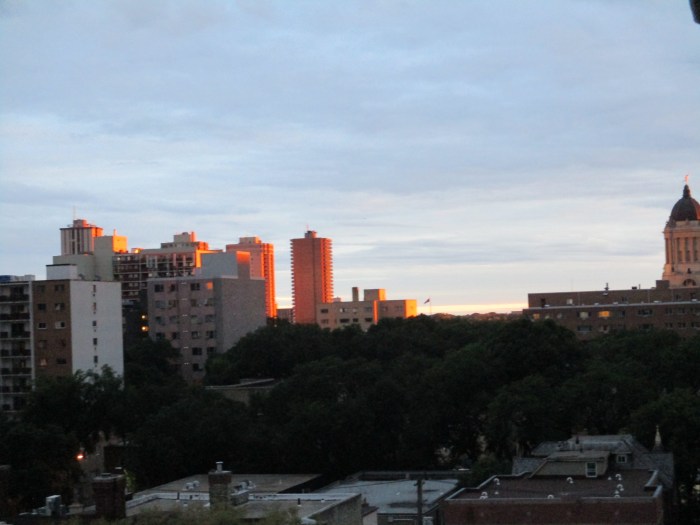
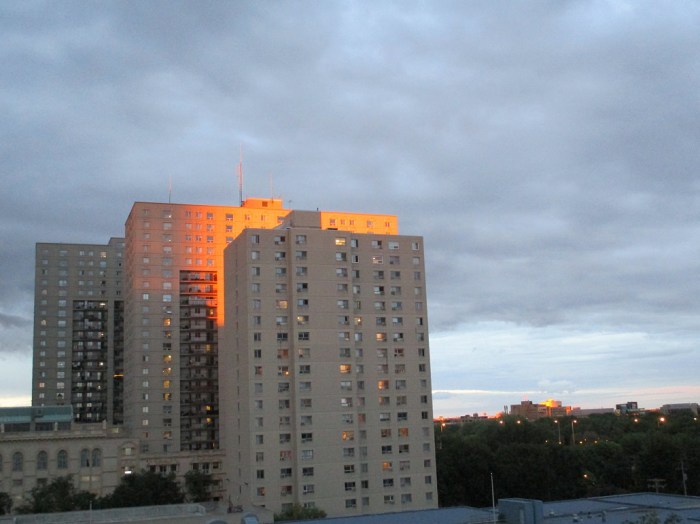
I’m glad I live in Manitoba.  I dislike blizzards and -30 wind chill.  But at least I don’t have to live with the threat of my apartment building shaking and collapsing from under me.

Photo from Chile:

These are the top ten cities in the world that face the most serious threat from earthquakes.

San Francisco

More than any other U.S. city, San Francisco is known for major earthquakes, most famously the 1906 quake that caused a fire that destroyed much of the city. Later research into the earthquake led to the discovery of the San Andreas Fault. Frisco remains at high risk for a big one: Between now and 2032, there’s a 62 percent chance of a quake stronger than 6.6 on the Richter scale.

Istanbul

Situated on the North Anatolian fault line—one of the most active in the world—Istanbul has been on earthquake watch for years and is what The Guardian once called “a disaster waiting to happen.” With 15 million residents and 1.6 million buildings, Istanbul is a difficult city to prepare for this kind of disaster, but recently officials have tightened regulations on buildings, and the World Bank has donated millions to aid in preparatory measures. Studies by the U.S. Geological Survey found as much as a 70 percent chance of a major earthquake in the city within the next three decades.

Tokyo

The Great Kanto Quake that rocked Tokyo in 1923 still ranks as one of the world’s worst disasters of the 20th century. Fires spread across the city and took two days to extinguish because the quake had ruptured water lines. Scientists think there’s a 70 percent chance that in the coming decades another big earthquake will wreak havoc the capital of Japan—the most quake-prone country in the world.

Los Angeles

Los Angeles also contains nearly 100 faults, and is one of the major cities along the San Andreas Fault Zone, which moves two inches per year. The most recent significant earthquake in L.A.’s history occurred in 1994, was 6.7 in magnitude, and was “the costliest U.S. earthquake since 1906.” The city is expected to experience at least one earthquake a year of magnitude 5.0 or greater, scientists say.

Tehran

Scientists estimate that a major earthquake could kill as many as a million people in Tehran, making it one of the most vulnerable cities to an earthquake in the world. Home to 8.5 million inhabitants and an unstable government, the metropolis lies on at least a hundred different fault lines, such a dangerous location that some have argued that Iran should pack up and move its entire capital city to a safer spot.

Manilla

A recent study found that Manila is at greater risk for an earthquake than was previously thought, and last year, a U.N. official made his concern apparent. “You’re gonna have 16,000 buildings destroyed. You’re gonna have…150,000 who are injured,” the head of the U.N.’s Emergency Services Branch told the BBC, predicting an imminent quake of between 7.0 and 8.0 magnitude in this city of 18 million. A colleague echoed his concern.“The big earthquake is certainly coming. The question is when? No one can tell. It can happen today, tomorrow, or next year. But certainly there will be an earthquake.

Mexico City

Haiti’s recent earthquake drew many comparisons to the one that struck Mexico City in 1985. The massive metropolitan area is home to over 21 million people, and the city itself was built on a dried-up lake bed, making the ground underneath like “a huge bowl of gelatin,” according to one researcher. Ominously, on the Earthquake Disaster Risk Index, Mexico City sits just higher than Santiago, Chile.

Quito

Geohazards International conducted an exhaustive study of what would happen to Ecuador’s capital city in the days and weeks following a major earthquake. It predicted severe structural damage due to the “vulnerable adobe” buildings, landslides that bury people and render roads impassable, a breakdown of the city’s water supply, sewage flooding the streets, and thousands of homeless people dying of exposure in the first night after the quake. “Human casualties would be substantial,” the hypothetical scenario states.

Anchorage

The Alaska Seismic Hazards Safety Commission says the 49th state is one of the most earthquake-prone areas in the world, and its largest city gets hit by a moderate tremor most years. The last one to do major damage was on Good Friday in 1964, and, at 9.2 on the Richter scale, it remains the strongest to afflict North America to date. Since then, Alaska’s population has more than doubled, and the Federal Emergency Management Agency estimates that “with the present infrastructure and policies, Alaska will have the second highest… earthquake-loss ratio in the country.”

Kathmandu

This Nepalese city is especially vulnerable thanks to its haphazardly constructed homes built with reinforced concrete and filled in with masonry. Experts have warned for years about Kathmandu’s lack of earthquake preparation, the danger intensified by its dense population. The last major quake happened in 1934, when nearly 17,000 city residents died in a minute

War of the Worlds in Slovakia

This structure in Slovakia has an uncanny resemblance to the giant creatures from War of the Worlds.

bufo2

By Kaushik

The Bridge of the Slovak National Uprising, commonly known as Most Slovenského národného povstania or Most SNP in short, is a road bridge over the Danube river in Bratislava, the capital city of Slovakia. The bridge was built in late 1960s and early ’70s at the height of Communist excess, in honor of the 1944 resistance movement against the Nazi forces. The very retro-futuristic SNP Bridge was inspired by the optimistic futurism of the 1960s, evident from the flying saucer-shaped structure at the top of the bridge’s only pylon. The UFO structure actually houses a restaurant reached using an elevator and offers a beautiful panoramic view of Bratislava.

bufo

The asymmetrical cable-stayed bridge is 431 meters long with a main span length of 303 m. Indeed, it’s the world’s longest cable-stayed bridge to have one pylon and one cable-stayed plane. The restaurant is located some 90 meters above the river below.

Although officially the bridge has been renamed to “New Bridge”, it’s still referred to by its old name of Most SNP or the UFO bridge.

bufo3

bufo5.

bufo6

bufo4

bufo1