Winnipeg Bloated Rivers

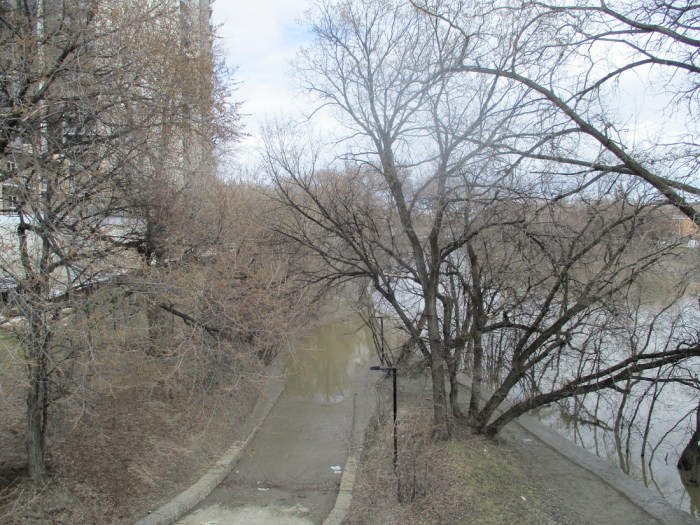
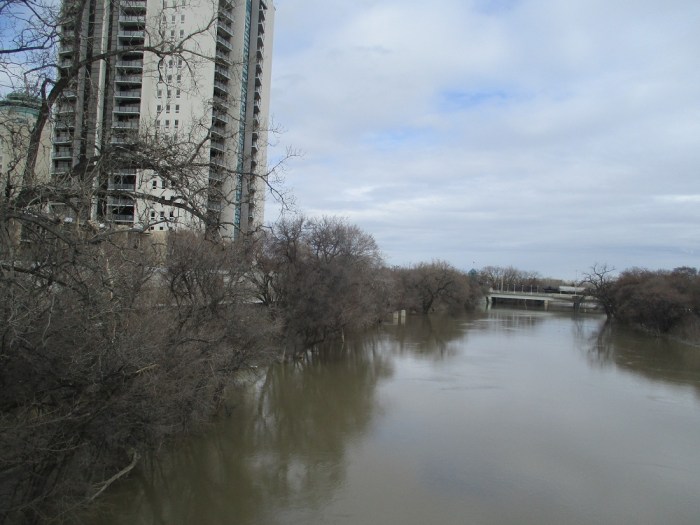
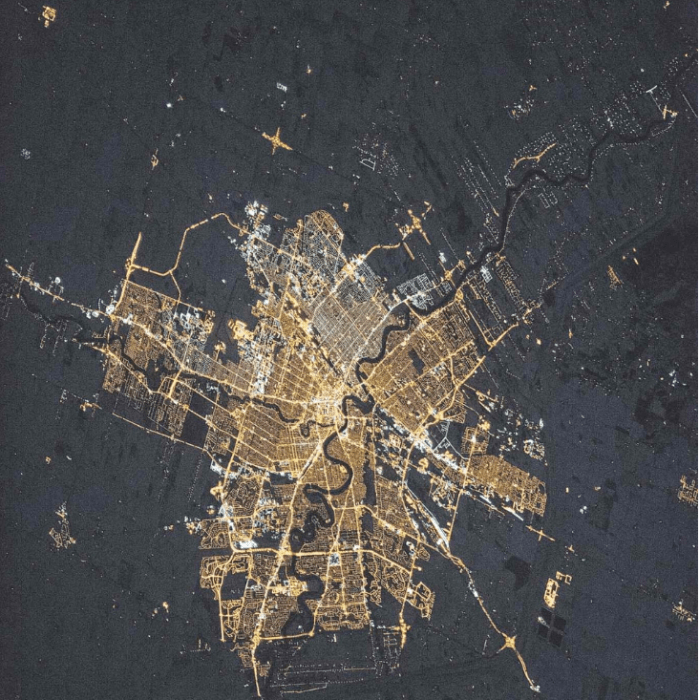
Almost every spring the two main rivers in Winnipeg rise way up. Winnipeg lies dab smack in the middle of a flood plain. This year the rivers have peaked and are starting to recede. They are still very high, but god forbid any heavy rains, the Red and Assiniboine should be okay.

Assiniboine today

mud2

mud1

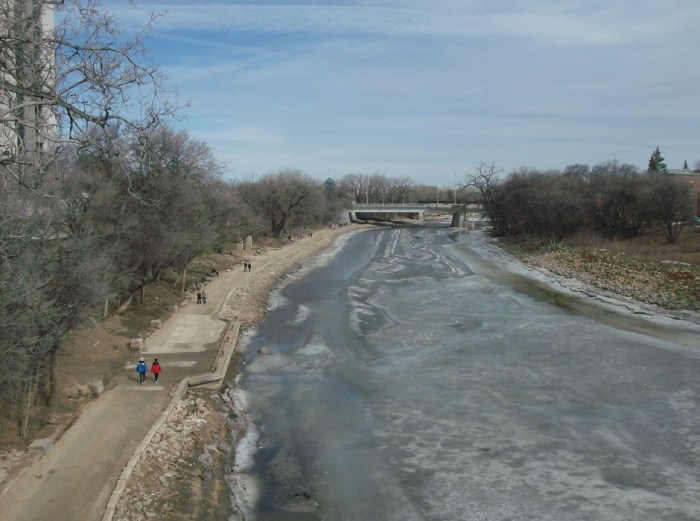
Regular level at the same location

mudx

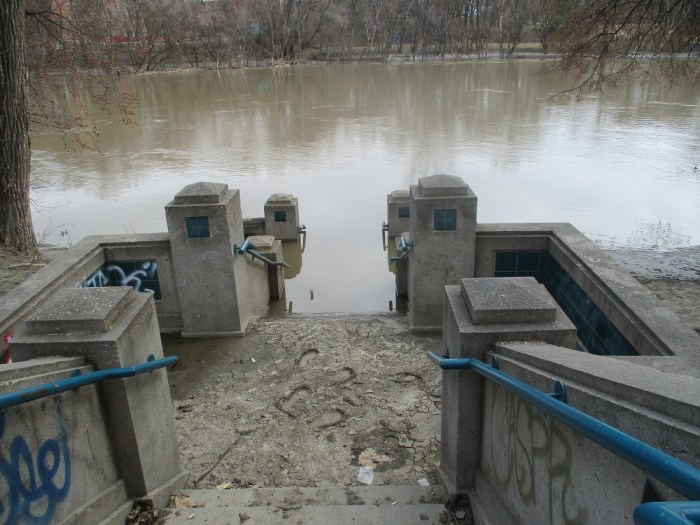
Mud shows how much the Assiniboine has receded

mud3

The Red lapping on some steps

The Unique Dragon Tree

Dracaena cinnabari, the Socotra dragon tree or dragon blood tree, is a dragon tree native to the Socotra archipelago in the Arabian Sea. It is so called due to the red sap that the trees produce.

trees1

The dragon blood tree has a unique and strange appearance, with an “upturned, densely packed crown having the shape of an uprightly held umbrella”. This evergreen species is named after its dark red resin, which is known as “dragon’s blood”. Unlike most monocot plants, Dracaena displays secondary growth, D. cinnabari even has growth zones resembling tree rings found in dicot tree species. Along with other arborescent Dracaena species it has a distinctive growth habit called “dracoid habitus”. Its leaves are found only at the end of its youngest branches; its leaves are all shed every 3 or 4 years before new leaves simultaneously mature. Branching tends to occur when the growth of the terminal bud is stopped, due to either flowering or traumatic events (e.g. herbivory).

trees

Socotra, also spelled Soqotra, is an island and a small archipelago of four islands in the Arabian Sea. Socotra is part of Yemen. It had long been a part of the Aden Governorate. In 2004 it became attached to the Hadhramaut Governorate, which is much closer to the island than Aden (although the nearest governorate was the Al Mahrah Governorate). In 2013, the archipelago became its own governorate.

trees3

trees2

trees5

Completely appears to be the surface of an Alien planet light years away.

trees4

trees6

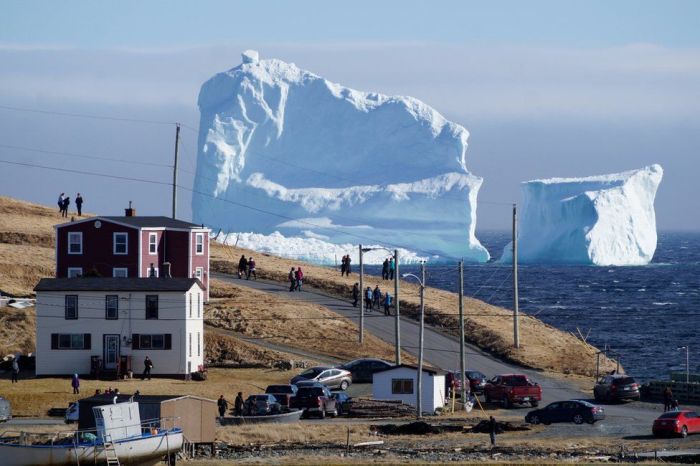
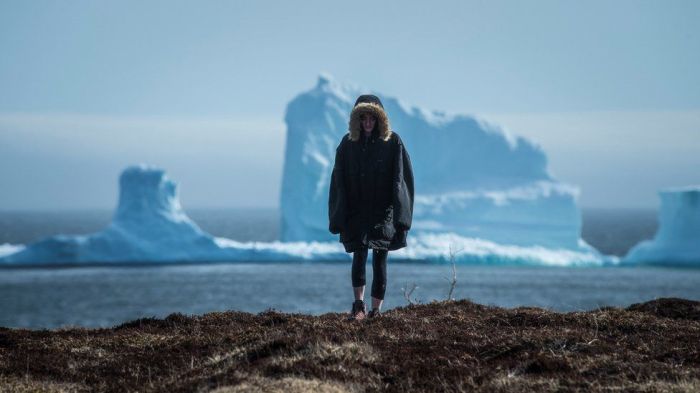
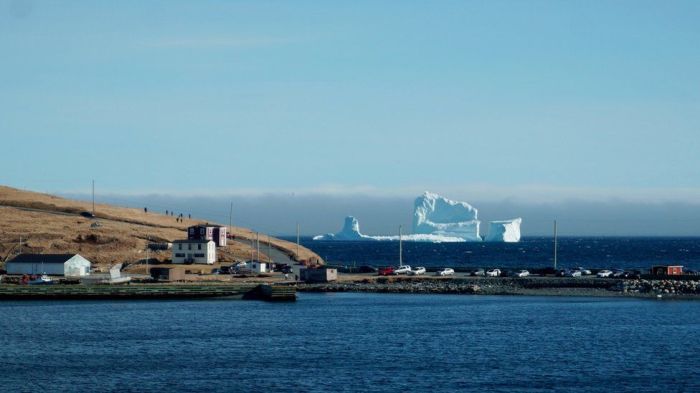
Awesome Iceberg brings tourists to tiny Newfoundland town

iceberg

A new natural attraction drew scores of tourists to a small town of around 500 people in Newfoundland, Canada over Easter weekend. A massive iceberg appeared near the coast, and photographers dashed to the area to snap pictures.
The Southern shore highway close to Ferryland filled with traffic over the weekend as tourists came to view the impressive iceberg. The Newfoundland coast area is commonly called iceberg alley due to the ice blocks that float down during the spring from the Arctic, but this particular huge iceberg might stay right where it is, according to Ferryland Mayor Adrian Kavanagh, who told The Canadian Press it’s the biggest one he’s ever seen in the area.

iceberg1

Usually just the tip of an iceberg is visible, with the rest of the mass beneath the waves, so many run aground when they float near the coast. Local Don Costello told CBC News the iceberg probably won’t be moving unless winds keep blowing because it’s stuck on shallow ground. He estimated the iceberg’s highest point is roughly 150 feet.
The BBC reported more icebergs are drifting through iceberg alley than is normal for this point in the year, with hundreds of icebergs in the Atlantic. This particular iceberg has moved around some and broken apart, but it appears it’ll stick around for a while.

iceberg3

iceberg2

I think the name of the town “Ferryland” should also cause tourism.

The Hottest Cities in the World

Winnipeg can experience sustained heat in the summer. Some days it gets up to +34-35.  But this heat is nothing compared to the cities below.  I doubt everyone in these cities have air conditioning.  The people obviously can take the heat.

At least two cities contend closely for the title of ‘Hottest City in the World’. What city ranks the hottest depends on how you look at the temperatures.  Here we compare the world’s most sweltering cities in terms of highest temperatures, hottest nights, and most days of extreme heat. So you can judge which is the World’s Hottest City.

In the world’s hottest cities, temperatures get above 40 degrees Celsius (104 degrees Fahrenheit) nearly every day for months at a time. Dozens of cities in the Middle East and Africa have extended periods of 40-degree weather.  It’s in deserts along the Persian Gulf, on the Arabian Peninsula and in Iraq and Iran, where cities have exceptionally searing summers. In two cities here, the heat rises above the rest. Only Kuwait City and Ahwaz report having months with daily maximum temperatures averaging above 46 °C (115 °F).

Kuwait City lies on the coast near the head of the Persian Gulf. Capital of the tiny country of Kuwait, the city itself houses just over 30 thousand people, but it adjoins other cities that together form a large metropolitan area extending into the desert.

Kuwait City

Ahwaz, also spelled Ahvaz, sprouts from the desert of western Iran with a population of close to a million.  Although inland from the Persian Gulf, Ahwaz sits at just 23 metres (75 feet) above sea level.

The only cities that come close to the regular 46-degree temperatures of Kuwait City and Ahwaz lie roughly between the two cities. In southern Iraq, maximum temperatures average 44.8 °C (112.6 °F) in July and August at An Nasiriya, while Al Amarah has average highs of 45.5 °C (113.9 °F) in July and 44.9 °C (112.8 °F) in August.

Ahwaz, Iran

How Hot is That?

A 46 °C climate is so hot that it’s well beyond the hottest weather ever experienced in many other countries. Forty-six Celsius tops by a degree ( 1.8 degrees F) Canada’s record high temperature and is 7.5 degrees C (13.5 degrees F) warmer than the hottest day in the United Kingdom. Temperatures that would break records in some counties are normal weather, day after day, for several months a year in the world’s hottest cities.

The only place in the United States with 46-degree heat is North America’s hottest spot, Death Valley in eastern California. Summer temperatures at Death Valley soar to average highs of 46.5 °C (115.7 °F) in July and 45.4 °C (113.8 °F) in August.

Death Valley, California

 Highest Daily Temperatures

Ahwaz and Kuwait are nearly equal in their average maximum temperatures during the year’s two hottest months. For both cities in July, highs average 46.7°C (116.1 °F).

Most Extreme Heat

Despite Kuwait City having a marginally greater average, Ahwaz leads the way in extreme temperatures. Several times Ahwaz has achieved temperatures higher than those ever recorded in Kuwait City.

From 1970 to 2000, Ahwaz made it to 52 °C (125.6 °F) or more on three days. Ahwaz had a high of 52.0 on July 12, 1971 and 52.2 °C (126 °F) on July 1, 2000. Neither of those broke any temperature records for the city, since it had already reached 54.0 °C (129.2 °F) on July 15, 1967.

Meanwhile, 52 °C has never been officially documented, as of 2010, in Kuwait City.

City With the Hottest Nights

In most hot cities when daytime temperatures top 40 °C, it usually cools down at night to the mid-20s. Just a few cities have a month of nighttime lows that stay above 30 °C (86 °F), and Kuwait City is one.

During the hottest months of the year, Ahwaz at night normally gets about a degree Celsius cooler than Kuwait City. But the Kuwaiti nights are not the warmest among cities.

Even hotter nights occur in Oman, a country located south of Kuwait on the Arabian Peninsula. Several cities in Oman stay above 30 °C at night in summer, including Buraimi, Sur and Rustaq, plus the capital, Muscat.  The country’s hottest city that measures weather is Samail, where from June to August nights generally don’t go below 30 degrees. Samail’s hottest nights are in July, which average 31.4 °C (88.5 °F), while the days climb to around 43 °C (109.4 °F).

Average monthly temperatures in °C for Kuwait City, Kuwait (1994-2008)
and Ahwaz, Iran (1994-2005).
Month Kuwait City Ahwaz, Iran
High Low High Low
January 19.5 8.5 18.1 8.9
February 21.8 10.0 20.9 9.8
March 26.9 14.0 25.6 13.4
April 33.9 19.5 32.8 19.1
May 40.9 25.4 40.2 24.3
June 45.5 28.9 45.0 27.3
July 46.7 30.7 46.7 29.8
August 46.9 29.5 46.8 29.1
September 43.7 26.2 42.7 24.7
October 36.6 21.5 36.4 20.3
November 27.8 14.5 26.6 13.8
December 21.9 9.9 19.7 10.0
Annual 34.3 19.9 33.5 19.2

North Korea: Proof that Insanity is Hereditary

North Korea is the first and only communist totalitarian family dynasty the world has seen.  I wonder what Marx and Lenin would think of this.  Sort of goes against the idea of equality and justice for all.

kim-jong-un-3-comb_1815141i

The Kim dynasty, officially called Mount Paektu Bloodline, is a three-generation lineage of North Korean leadership descending from the country’s first leader, Kim Il-sung, in 1948. Kim came to rule the North after the end of Japanese control in 1945 split the region. He began the Korean War in 1950 in an attempt to reunify the peninsula. Kim developed a cult of personality closely tied to their state philosophy of Juche, which was passed on to his successors: his son Kim Jong-il and grandson Kim Jong-un.
In 2013, Clause 2 of Article 10 of the new edited Ten Fundamental Principles of the Korean Workers’ Party states that the party and revolution must be carried “eternally” by the “Baekdu bloodline”.

kim-family-photo

kimx1


kim2

Kim-Jong-Un-Cartoon2

kimx

Russian anti-alcohol posters from the late Soviet era

1972-1988

Soviet anti-alcohol posters

In Soviet Russia, alcohol consumes YOU!

by Alex Q. Arbuckle

c. 1986

“Little by little, and you end up with a hooligan. Tolerance of drinking is dangerous. There is but a step from drinking to crime.”

From the 1960s through the 1980s, artists throughout the Soviet Union designed propaganda posters to warn the public of the dangers of excessive alcohol consumption.

With striking, colorful graphics and stark metaphors, the posters cast alcoholism as a snake choking the life from vivacious young men, a bottle as a prison, and more.

Drinkers grow slothful and lazy, abandon their families, endanger their coworkers, or become murderous brutes.

1988

“Underpass — to the ‘next world.'”

IMAGE: S. SMIRNOV/ALCOHOL BY FUEL PUBLISHING

1985

“We will overcome!” (Text on snake: “Alcoholism.”)

IMAGE: E. BOR/ALCOHOL BY FUEL PUBLISHING

1972

“Not among trees or grasses, the serpent has warmed up among us. Don’t suck on him, mammals, or you’ll turn into a reptile yourself.”

1977

“Don’t drink your life away.”

IMAGE: I.M. MAISTROVSKY/ALCOHOL BY FUEL PUBLISHING

1987

“His inner world.”

IMAGE: P.D. YEGOROV/ALCOHOL BY FUEL PUBLISHING

1980

“This is a shameful union — a slacker + vodka!”

IMAGE: V.O. PUSHENKO/ALCOHOL BY FUEL PUBLISHING