New York Times
SEAL Team 6: A Secret History of Quiet Killings and Blurred Lines
The unit best known for killing Osama bin Laden has been converted into a global manhunting machine with limited outside oversight.
They have plotted deadly missions from secret bases in the badlands of Somalia. In Afghanistan, they have engaged in combat so intimate that they have emerged soaked in blood that was not their own. On clandestine raids in the dead of the night, their weapons of choice have ranged from customized carbines to primeval tomahawks.
Around the world, they have run spying stations disguised as commercial boats, posed as civilian employees of front companies and operated undercover at embassies as male-female pairs, tracking those the United States wants to kill or capture.
Those operations are part of the hidden history of the Navy’s SEAL Team 6, one of the nation’s most mythologized, most secretive and least scrutinized military organizations. Once a small group reserved for specialized but rare missions, the unit best known for killing Osama bin Laden has been transformed by more than a decade of combat into a global manhunting machine.
That role reflects America’s new way of war, in which conflict is distinguished not by battlefield wins and losses, but by the relentless killing of suspected militants.
Almost everything about SEAL Team 6, a classified Special Operations unit, is shrouded in secrecy — the Pentagon does not even publicly acknowledge that name — though some of its exploits have emerged in largely admiring accounts in recent years. But an examination of Team 6’s evolution, drawn from dozens of interviews with current and former team members, other military officials and reviews of government documents, reveals a far more complex, provocative tale.
While fighting grinding wars of attrition in Afghanistan and Iraq, Team 6 performed missions elsewhere that blurred the traditional lines between soldier and spy. The team’s sniper unit was remade to carry out clandestine intelligence operations, and the SEALs joined Central Intelligence Agency operatives in an initiative called the Omega Program, which offered greater latitude in hunting adversaries.
Team 6 has successfully carried out thousands of dangerous raids that military leaders credit with weakening militant networks, but its activities have also spurred recurring concerns about excessive killing and civilian deaths.
Afghan villagers and a British commander accused SEALs of indiscriminately killing men in one hamlet; in 2009, team members joined C.I.A. and Afghan paramilitary forces in a raid that left a group of youths dead and inflamed tensions between Afghan and NATO officials. Even an American hostage freed in a dramatic rescue has questioned why the SEALs killed all his captors.
When suspicions have been raised about misconduct, outside oversight has been limited. Joint Special Operations Command, which oversees SEAL Team 6 missions, conducted its own inquiries into more than a half-dozen episodes, but seldom referred them to Navy investigators. “JSOC investigates JSOC, and that’s part of the problem,” said one former senior military officer experienced in special operations, who like many others interviewed for this article spoke on the condition of anonymity because Team 6’s activities are classified.
Waves of money have sluiced through SEAL Team 6 since 2001, allowing it to significantly expand its ranks — reaching roughly 300 assault troops, called operators, and 1,500 support personnel — to meet new demands. But some team members question whether the relentless pace of operations has eroded the unit’s elite culture and worn down Team 6 on combat missions of little importance. The group was sent to Afghanistan to hunt Qaeda leaders, but instead spent years conducting close-in battle against mid- to low-level Taliban and other enemy fighters. Team 6 members, one former operator said, served as “utility infielders with guns.”
The cost was high: More members of the unit have died over the past 14 years than in all its previous history. Repeated assaults, parachute jumps, rugged climbs and blasts from explosives have left many battered, physically and mentally.
“War is not this pretty thing that the United States has come to believe it to be,” said Britt Slabinski, a retired senior enlisted member of Team 6 and veteran of combat in Afghanistan and Iraq. “It’s emotional, one human being killing another human being for extended periods of time. It’s going to bring out the worst in you. It’s also going to bring out the best in you.”
Team 6 and its Army counterpart, Delta Force, have delivered intrepid performances that have drawn the nation’s two most recent presidents to deploy them to an expanding list of far-off trouble spots. They include Syria and Iraq, now under threat from the Islamic State, and Afghanistan, Somalia and Yemen, mired in continuing chaos.
Like the C.I.A.’s campaign of drone strikes, Special Operations missions offer policy makers an alternative to costly wars of occupation. But the bulwark of secrecy around Team 6 makes it impossible to fully assess its record and the consequences of its actions, including civilian casualties or the deep resentment inside the countries where its members operate. The missions have become embedded in American combat with little public discussion or debate.
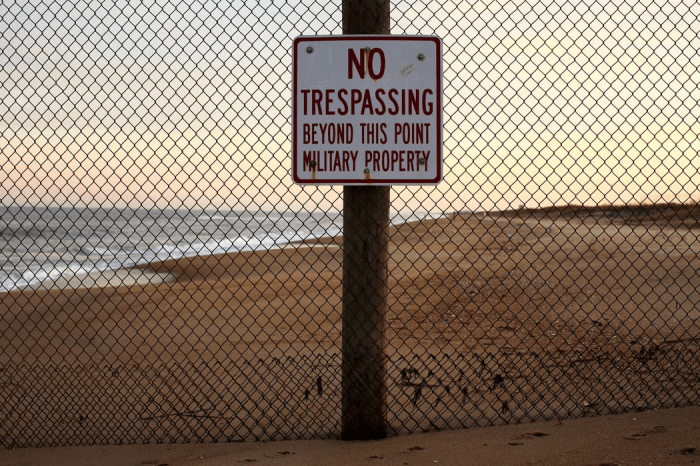
SEAL Team 6’s headquarters are just south of Virginia Beach, in an area closed off to the public. Credit Travis Dove for The New York Times
But others warn of the seduction of an endless campaign of secret missions, far from public view. “If you’re unacknowledged on the battlefield,” said William C. Banks, an expert on national security law at Syracuse University, “you’re not accountable.”

A Heckler & Koch MP7 firearm, top, fitted with a suppressor to reduce muzzle flashes and sounds, and an MP5, a submachine gun widely used by law enforcement officers. In the American military, the MP7 is used only by Delta Force and SEAL Team 6. Some police SWAT teams have also bought it. Credit Doug Mills/The New York Times
The Culture
SEAL Team 6’s fenced-off headquarters at the Dam Neck Annex of the Oceana Naval Air Station, just south of Virginia Beach, houses a secretive military within the military. Far removed from the public eye, the base is home not just to the team’s 300 enlisted operators (they disdain the term “commandos”), their officers and commanders, but also to its pilots, Seabee builders, bomb disposal technicians, engineers, medical crews and an intelligence unit equipped with sophisticated surveillance and global tracking technology.
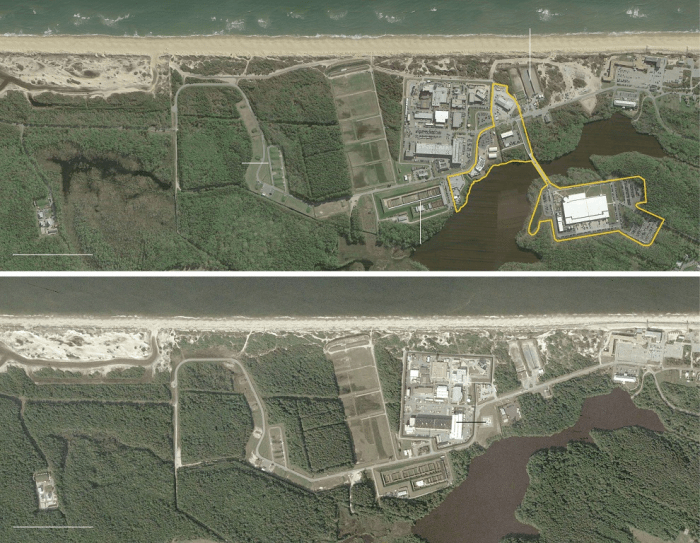
SEAL Team 6 headquarters in Virgin. Top photo shows expansion of the facility in the last few years.
The Navy SEALs — the acronym stands for Sea, Air, Land forces — evolved from the frogmen of World War II. Team 6 arose decades later, born out of the failed 1980 mission to rescue 53 American hostages seized in the takeover of the United States Embassy in Tehran. Poor planning and bad weather forced commanders to abort the mission, and eight servicemen died when two aircraft collided over the Iranian desert.
He flouted rules and fostered a maverick image for the unit. (Years after leaving the command, he was convicted of military contract fraud.) In his autobiography, “Rogue Warrior,” Commander Marcinko describes drinking together as important to SEAL Team 6’s solidarity; his recruiting interviews often amounted to boozy chats in a bar.
Inside Team 6, there were initially two assault groups, called Blue and Gold, after the Navy colors. Blue used the Jolly Roger pirate flag as its insignia and early on earned the nickname “the Bad Boys in Blue,” for racking up drunken driving arrests, abusing narcotics and crashing rental cars on training exercises with near impunity.
Young officers sometimes were run out of Team 6 for trying to clean up what they perceived as a culture of recklessness. Adm. William H. McRaven, who rose to head the Special Operations Command and oversaw the Bin Laden raid, was pushed out of Team 6 and assigned to another SEAL team during the Marcinko era after complaining of difficulties in keeping his troops in line.
Ryan Zinke, a former Team 6 officer and now a Republican congressman from Montana, recalled an episode after a team training mission aboard a cruise liner in preparation for potential hostage rescues at the 1992 Summer Olympics in Barcelona, Spain. Mr. Zinke escorted an admiral to a bar in the ship’s lower level. “When we opened the door, it reminded me of ‘Pirates of the Caribbean,’” Mr. Zinke said, recalling that the admiral was appalled by the operators’ long hair, beards and earrings. “My Navy?” the admiral asked him. “These guys are in my Navy?”
That was the beginning of what Mr. Zinke referred to as “the great bloodletting,” when the Navy purged Team 6’s leadership to professionalize the force. Current and former Team 6 operators said the culture was different today. Members now tend to be better educated, more athletic, older and more mature — though some are still known for pushing limits.
“I got kicked out of the Boy Scouts,” said one former officer. Most Team 6 SEALs, he added, “were like me.”
Delta Force members, who have a reputation for going by the book, often start out as regular infantry, then move up through the Army’s Ranger units and Special Forces teams before joining Delta. But SEAL Team 6 is more isolated from the rest of the Navy, with many of its men entering the brutal SEAL training pipeline from outside the military.
After several years on regular SEAL teams — the even-numbered ones based in Virginia Beach, the odd-numbered ones in San Diego, and a unit in Hawaii dedicated to mini-submarines — SEALs can try out for Team 6. Many are eager to get to the most elite unit, but about half of them wash out.
Officers rotate through Team 6, sometimes returning for several tours, but the enlisted SEALs typically stay far longer, giving them outsize influence. “A lot of the enlisted guys think that they really run the show,” said one former senior member. “That’s part of the Marcinko style.”
And they tend to swagger, critics and defenders say. While the other SEAL teams (called “white” or “vanilla” SEALs within the military) perform similar tasks, Team 6 pursues the highest value targets and takes on hostage rescues in combat zones. It also works more with the C.I.A. and does more clandestine missions outside war zones. Only Team 6 trains to chase after nuclear weapons that fall into the wrong hands.
Latitude to Kill
Early on in the Afghan war, SEAL Team 6 was assigned to protect the Afghan leader Hamid Karzai; one of the Americans was grazed in the head during an assassination attempt on the future president. But in the years that followed, Mr. Karzai became a bitter critic of the United States Special Operations troops, complaining that they routinely killed civilians in raids. He viewed the activities of Team 6 and other units as a boon for Taliban recruiting and eventually tried to block night raids entirely.
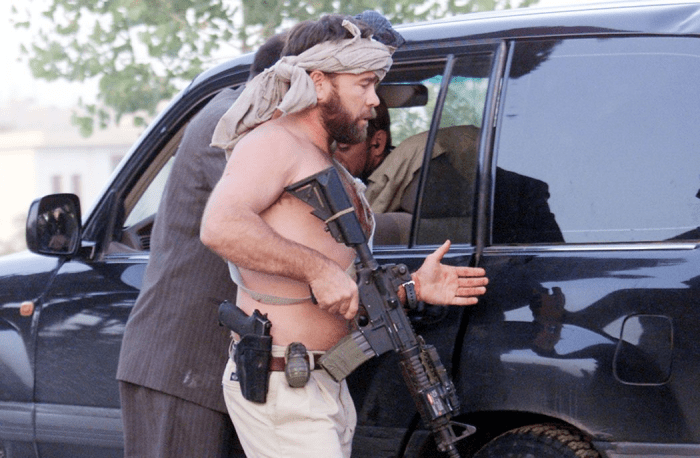
SEAL Team 6 was assigned to protect the Afghan leader Hamid Karzai. After an assassination attempt in 2002 in Kandahar, a team member whose head was wounded used his shirt to stanch the bleeding.
Most missions were not lethal. Several Team 6 members said they herded women and children together and knocked men out of the way, with a push or a gun muzzle, to search homes. They frequently took prisoners; a number of detainees had broken noses after SEALs punched them in struggles to subdue them, one officer said.
The Team 6 members often operate under the watchful eyes of their commanders — officers at overseas operations centers and at Dam Neck can routinely view live surveillance feeds of raids provided by drones high above — but are also given wide latitude. While Special Operations troops functioned under the same rules of engagement as other military personnel in Afghanistan, Team 6 members routinely performed their missions at night, making life-or-death decisions in dark rooms with few witnesses and beyond the view of a camera.
Operators would use weapons with suppressors to quietly kill enemies as they slept, an act that they defend as no different from dropping a bomb on an enemy barracks. “I snuck into people’s houses while they were sleeping,” Mr. Bissonnette says in his book “No Hero,” written under the pseudonym Mark Owen. “If I caught them with a gun, I killed them, just like all the guys in the command.”
And their decisions tend to be certain. Noting that they shoot to kill, a former noncommissioned officer added that the operators fire “security rounds” into those who are down to ensure that they are dead. (In a 2011 mission on a hijacked yacht off the coast of Africa, one Team 6 member slashed a pirate with a knife and left 91 wounds, according to a medical examiner, after the man and other attackers killed four American hostages. Operators are trained “to slice and dice every major artery,” said one former SEAL.)
After years of refining techniques to sneak up on enemy compounds, Team 6 members were often required to “call out” before attacking a site, akin to a sheriff announcing through a bullhorn, “Come out with your hands up.”
One Operator said that civilian casualties occurred most often during the “call out” operations, which were meant to mitigate exactly such losses. Enemy combatants, he said, would sometimes send out family members and then shoot from behind them, or give civilians flashlights and tell them to point out American positions.
Mr. O’Neill, the former Team 6 member, agreed that the rules could be frustrating. “What we found was, the more latitude for collateral damage that they gave us, the more effective we were because we’re not going to take advantage of it but we know we’re not going to be second-guessed,” he said in an interview. “When there were more rules, it did get more difficult.”
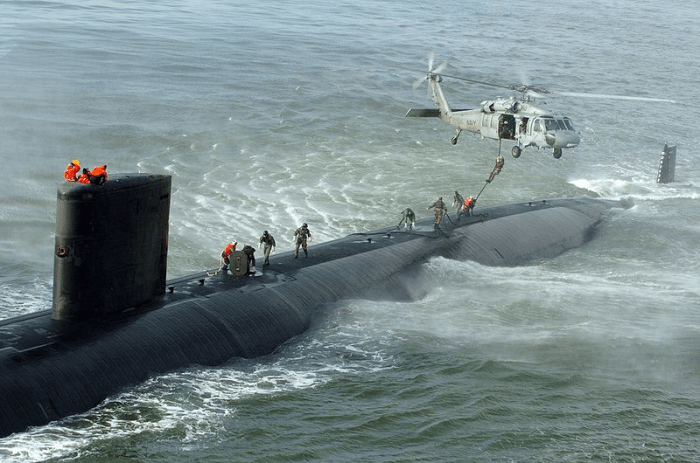
SEALS transferring to a sub
A Global Spying Force
 The MarkoZen Blog